Foreigners can obtain St Kitts and Nevis citizenship by:
- descent,
- adoption,
- marriage,
- naturalisation,
- investment.
Each pathway has its own requirements for potential applicants.
Foreigners obtain St Kitts and Nevis citizenship by descent, adoption, marriage, naturalisation, or investment. Each pathway has its requirements. For example, citizenship by naturalisation is granted after 14 years of residence in the country.
The article explores all ways to obtain St Kitts and Nevis citizenship, as well as procedures and related expenses.




There are five primary ways to obtain St Kitts and Nevis citizenship:
Investment is the most popular way to become a St Kitts and Nevis citizen as it is the fastest and the simplest method. Investors receive passports in 6 or more months without the need to reside in the country.
People choose St Kitts and Nevis citizenship to create a safe haven, expand businesses, open European bank accounts, optimise taxes, or enjoy visa-free travel.
Another benefit of St Kitts and Nevis is the recognition of dual and multiple citizenships. Upon obtaining a passport, foreigners do not need to renounce their other citizenships.
Children born in the country obtain citizenship by birth.
Citizenship by descent in St Kitts and Nevis is granted to foreigners with at least one parent or grandparent holding the country’s passport. A birth certificate of a St Kittian citizen must prove this.
Adopted children obtain St Kitts and Nevis citizenship if they are minors and at least one of their adopters is a citizen of the country.
Documents. For those obtaining a passport by descent, the list of required documents includes:
In case of adoption, the applicant also provides an adoption certificate.
Fees. Upon filing an application, the foreigner pays a fee of $88[1].
Any person married to a St Kitts and Nevis national can obtain citizenship of the country, provided the couple has been married for at least three years.
Documents. The applicant submits the following documents:
The documents are to be sent to the Ministry of National Security and Information.
Fees. The applicant pays $185 if the couple was married before 1983; for marriages after 1983, the fee is $370[2].
To obtain St Kitts and Nevis citizenship by naturalisation, the foreigner must legally reside in the country for at least 14 years[3]. They must also be of good character, not pose a threat to the safety or law and order of St Kitts and Nevis, and intend to continue residing in the country.
The person who has served the St Kitts and Nevis government can obtain citizenship by naturalisation in fewer than 14 years.
The basic list of documents for the application include:
The foreigner pays $200 per application when obtaining temporary and permanent residency[4].
To obtain St Kitts and Nevis citizenship by naturalisation, the foreigner must undergo the following steps:
Foreigners can obtain St Kitts and Nevis citizenship by investment if they contribute to the country’s economy[5]. Three options are available: a real estate purchase, a non-refundable contribution, and investment in a Public Benefit Project. The waiting time starts at 4 months.
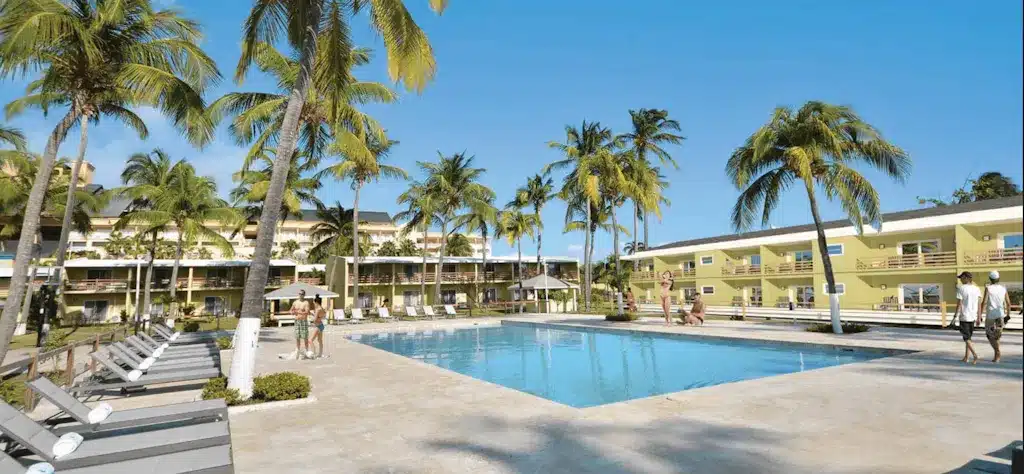
There are three real estate investment options:
The sum doesn’t depend on the family composition.
The property or share must be kept for at least 7 years; after that, it can be sold at a profit. Renting real estate out is allowed, bringing an additional 2 to 5% annually.

The applicant invests in the Federal Consolidated Fund, which contributes money to developing healthcare, alternative energy, education, tourism, and cultural initiatives.
The minimum contribution is $250,000 for a single applicant or a family of up to four. Each additional dependant under 18 adds $25,000, while each additional dependant aged 18 or older adds $50,000.
The applicant contributes to a social or infrastructural project approved by the government. Public Benefit Projects aim to provide jobs for locals and facilitate the implementation of projects that include the development of technology and increasing economic potential. The investment sum doesn’t depend on the number of applicants and remains flat.
The Public Benefit Option offers two projects requiring the same minimum investment:
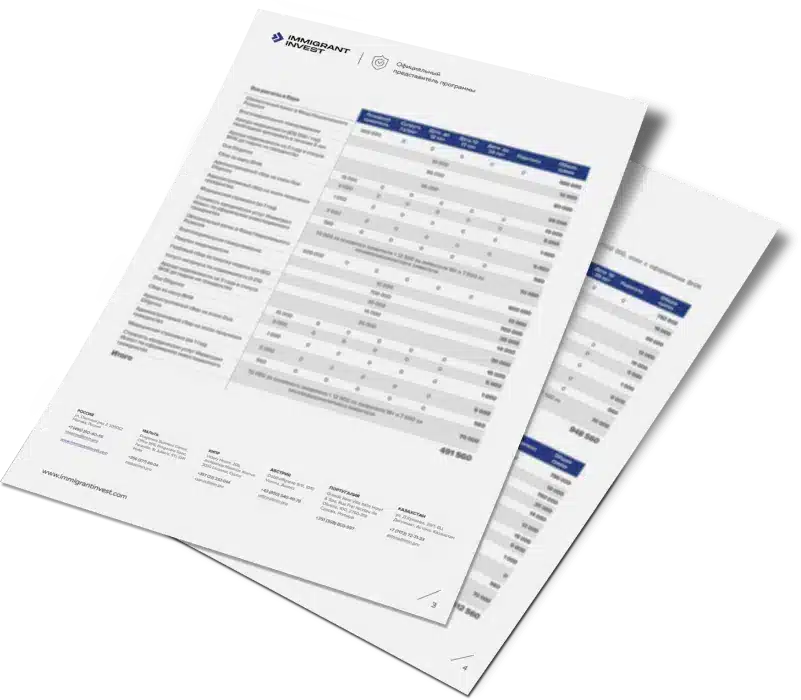
The total cost of St Kitts and Nevis citizenship includes the required investment and the following additional fees:
For real estate purchases and the National Housing Corporation project, the main applicant pays a state fee of $25,000. Additional fees are $15,000 for a spouse, $10,000 for each dependant under 18, and $15,000 for each dependant aged 18 or over. These routes also carry a processing fee of $2,500 for a family of up to 5 and $3,500 for a family of 5 or more.
Under the Prime Creative Arts Centre option, the main applicant does not pay a state fee. However, additional fees apply to included family members: $15,000 for a spouse, $10,000 for each dependant under 18, and $15,000 for each dependant aged 18 or over.
Under the Sustainable Island State Contribution option, no state fees apply.
| Option | Investment | State fee | Due Diligence | Other fees | Total |
| Real estate purchase | $325,000+ | $25,000 | $10,000 | $6,211 | $366,211+ |
| Fund contribution | $250,000+ | — | $10,000 | $3,711 | $263,711+ |
| National Housing Corporation | $250,000+ | $25,000 | $10,000 | $6,211 | $291,211+ |
| Prime Creative Arts Centre | $250,000+ | — | $10,000 | $3,711 | $263,711+ |
St Kitts and Nevis citizenship by investment is designed for financially secure applicants who meet specific eligibility criteria, can include close family members in their application, and are prepared to provide a set of personal and financial documents to confirm their suitability.
Applicants participating in the St Kitts and Nevis Citizenship by Investment programme must meet the following requirements:
The investor can add their spouse, children under 25, and parents over 55 to the application.
Children between 18 and 25 must be studying at a recognised secondary or tertiary-level educational institution and be financially dependent on the investor. A spouse must have no criminal record and be of the opposite sex. Parents must be financially dependent on the investor.
The basic list of required documents includes:
Depending on the investor’s situation and background, they might be required to provide additional documents.
In Immigrant Invest’s experience, obtaining citizenship by investment takes at least 4 months. Most application stages are completed remotely, but applicants must attend an approved centre for biometric enrolment and collect the Certificate of Registration in person.
Immigrant Invest accompanies clients throughout the entire process.
Immigrant Invest checks the investor against international databases, which helps identify potential risks of refusal. If there are any, lawyers suggest ways to decrease them, such as submitting additional documents or choosing another programme.
The check is completely confidential, and the investor provides only their passport. In the end, preliminary Due Diligence helps to decrease refusal risks to 1%.
If the check is successful, Immigrant Invest signs an agreement with the investor.
Immigrant Invest managers offer real estate options and assist applicants in choosing the best property.
The investor signs a sales purchase contract with a developer, opens an escrow account, and transfers 10% of the property’s cost.
Lawyers provide the investor with a list of required documents. Once they are ready, lawyers notarise and apostille the documents and help translate them into English if necessary.
The documents are sent to the St Kitts and Nevis Citizenship by Investment Unit.
The St Kitts and Nevis CBI Unit checks all the investors against international databases, such as Interpol and Europol. If the country’s authorities have questions, they can request additional documents. In this case, the duration of the Due Diligence process extends.
The main applicant must attend an online interview during Due Diligence. Dependants over 16 may also be required to participate. The interview is held in English or the investors’ native language.
Once the St Kitts and Nevis CBI application is approved, the investor pays the remaining 90% of the property’s purchase price and books a biometric enrolment appointment.
Biometric data can be submitted either in St Kitts and Nevis or at one of the authorised biometric collection centres located across Asia, Europe, the Middle East, or North America.
On the appointed date, all family members included in the application attend the biometric appointment to provide their fingerprints, signatures, and photographs. The process usually takes 15 to 30 minutes.
The investors collect their documents personally in St Kitts and Nevis or at the country’s consulate or embassy.
The St Kitts and Nevis passport is granted for 10 years; children under 16 receive it for 5 years. It can be renewed or restored if:
To restore the lost or stolen passport, the citizen must:
Renewal for CBI participants costs EC$675, or ≈ $250. The state fee for a passport replacement for CBI participants is EC$1,350, or ≈ $500.
While St Kitts and Nevis citizenship provides many benefits, it can be withdrawn in specific circumstances. Citizenship may be revoked in cases of fraud or serious offences, and individuals also have the option to voluntarily renounce it under certain conditions[3].
St Kitts and Nevis citizenship can be revoked if it was obtained through fraud, false representation, or concealment.
Other possible reasons for losing the St Kitts and Nevis passport include:
Any St Kitts and Nevis citizen over the age of 18 can renounce their citizenship by declaration if they are citizens of another country or intend to become one soon. If the person doesn’t acquire a passport from another country within six months after renouncing the St Kitts and Nevis one, they will revert to being citizens of St Kitts and Nevis.
St Kitts and Nevis citizenship can simplify international travel, support global business, and provide long-term security. Here are nine reasons why investors choose to become citizens of the Caribbean nation.
St Kitts and Nevis citizens can obtain a B-1/B-2 visa to the US, valid for 10 years, immediately. With this visa, they can travel around the country, attend business meetings, or receive treatment in American clinics.
St Kitts and Nevis citizens can enter many countries around the world without a visa. Some states require them to obtain visas on arrival or Electronic Travel Authorizations, eTA, which can be prepared in as little as several minutes.
| Country | Region | Conditions of entry |
| Albania | Europe | Visa-free |
| Andorra | Europe | Visa-free |
| Angola | Africa | Visa-free |
| Antigua and Barbuda | The Caribbeans | Visa-free |
| Argentina | South America | Visa-free |
| Armenia | Middle East | eTA |
| Australia | Oceania | eTA |
| Austria | Europe | Visa-free |
| Bahamas | The Caribbean | Visa-free |
| Bahrain | Middle East | eTA |
| Bangladesh | Asia | Visa-free |
| Barbados | The Caribbean | Visa-free |
| Belarus | Europe | Visa-free |
| Belgium | Europe | Visa-free |
| Belize | Central America | Visa-free |
| Benin | Africa | eTA |
| Bhutan | Asia | eTA |
| Bolivia | South America | Visa upon arrival |
| Bosnia and Herzegovina | Europe | Visa-free |
| Botswana | Africa | Visa-free |
| Brazil | South America | Visa-free |
| Bulgaria | Europe | Visa-free |
| Burkina Faso | Africa | eTA |
| Burundi | Africa | Visa upon arrival |
| Cambodia | Asia | Visa upon arrival |
| Cameroon | Africa | Visa upon arrival |
| Cape Verde | Africa | eTA |
| Chile | South America | Visa-free |
| Colombia | South America | Visa-free |
| Comoros | Africa | Visa upon arrival |
| Congo Kinshasa | Africa | eTA |
| Costa Rica | Central America | Visa-free |
| Croatia | Europe | Visa-free |
| Cuba | The Caribbean | Visa-free |
| Cyprus | Europe | Visa-free |
| Czechia | Europe | Visa-free |
| Côte d’Ivoire | Africa | eTA |
| Denmark | Europe | Visa-free |
| Djibouti | Africa | eTA |
| Dominica | The Caribbean | Visa-free |
| Dominican Republic | The Caribbean | Visa-free |
| Ecuador | South America | Visa-free |
| El Salvador | Central America | Visa-free |
| Equatorial Guinea | Africa | eTA |
| Estonia | Europe | Visa-free |
| Ethiopia | Africa | eTA |
| Fiji | Oceania | Visa-free |
| Finland | Europe | Visa-free |
| France | Europe | Visa-free |
| Gabon | Africa | eTA |
| Gambia | Africa | Visa-free |
| Georgia | Europe | eTA |
| Germany | Europe | Visa-free |
| Greece | Europe | Visa-free |
| Grenada | The Caribbean | Visa-free |
| Guatemala | Central America | Visa-free |
| Guinea | Africa | eTA |
| Guinea-Bissau | Africa | Visa upon arrival |
| Guyana | South America | Visa-free |
| Haiti | The Caribbean | Visa-free |
| Honduras | Central America | Visa-free |
| Hungary | Europe | Visa-free |
| Iceland | Europe | Visa-free |
| India | Asia | eTA |
| Iran | Middle East | eTA |
| Israel | Middle East | Visa-free |
| Italy | Europe | Visa-free |
| Jamaica | The Caribbean | Visa-free |
| Jordan | Middle East | Visa upon arrival |
| Kazakhstan | Asia | Visa-free |
| Kenya | Africa | Visa-free |
| Kiribati | Oceania | Visa-free |
| Kyrgyzstan | Asia | eTA |
| Laos | Asia | Visa upon arrival |
| Latvia | Europe | Visa-free |
| Lebanon | Middle East | Visa upon arrival |
| Lesotho | Africa | Visa-free |
| Liechtenstein | Europe | Visa-free |
| Lithuania | Europe | Visa-free |
| Luxembourg | Europe | Visa-free |
| Madagascar | Africa | Visa upon arrival |
| Malawi | Africa | Visa-free |
| Malaysia | Asia | Visa-free |
| Malta | Europe | Visa-free |
| Mauritania | Africa | Visa upon arrival |
| Mauritius | Africa | Visa-free |
| Micronesia | Oceania | Visa-free |
| Moldova | Europe | Visa-free |
| Monaco | Europe | Visa-free |
| Mongolia | Asia | eTA |
| Montenegro | Europe | Visa-free |
| Mozambique | Africa | Visa upon arrival |
| Nepal | Asia | Visa upon arrival |
| Netherlands | Europe | Visa-free |
| Nicaragua | Central | Visa-free |
| Nigeria | Africa | eTA |
| North Macedonia | Europe | Visa-free |
| Norway | Europe | Visa-free |
| Oman | Middle East | eTA |
| Pakistan | Middle East | eTA |
| Palau | Oceania | Visa upon arrival |
| Panama | Central America | Visa-free |
| Papua New Guinea | Oceania | eTA |
| Peru | South America | Visa-free |
| Philippines | Asia | Visa-free |
| Poland | Europe | Visa-free |
| Portugal | Europe | Visa-free |
| Romania | Europe | Visa-free |
| Russia | Europe | Visa-free |
| Rwanda | Africa | Visa-free |
| Samoa | Oceania | Visa upon arrival |
| San Marino | Europe | Visa-free |
| Senegal | Africa | Visa upon arrival |
| Serbia | Europe | Visa-free |
| Seychelles | Africa | Visa-free |
| Sierra Leone | Africa | Visa upon arrival |
| Singapore | Asia | Visa-free |
| Slovakia | Europe | Visa-free |
| Slovenia | Europe | Visa-free |
| Solomon Islands | Oceania | Visa upon arrival |
| Somalia | Africa | Visa upon arrival |
| South Korea | Asia | eTA |
| South Sudan | Africa | eTA |
| Spain | Europe | Visa-free |
| Sri Lanka | Asia | eTA |
| St Lucia | The Caribbean | Visa-free |
| St Vincent and Grenadines | The Caribbean | Visa-free |
| Suriname | South America | Visa-free |
| Sweden | Europe | Visa-free |
| Switzerland | Europe | Visa-free |
| São Tomé and Príncipe | Africa | eTA |
| Tajikistan | Asia | eTA |
| Tanzania | Africa | Visa-free |
| Thailand | Asia | eTA |
| Timor-Leste | Asia | Visa upon arrival |
| Togo | Africa | Visa upon arrival |
| Tonga | Oceania | Visa upon arrival |
| Trinidad and Tobago | The Caribbean | Visa-free |
| Tunisia | Africa | Visa-free |
| Turkey | Europe | Visa-free |
| Tuvalu | Oceania | Visa upon arrival |
| Uganda | Africa | eTA |
| Ukraine | Europe | Visa-free |
| United Kingdom | Europe | eTA |
| Uruguay | South America | Visa-free |
| Uzbekistan | Asia | Visa-free |
| Vanuatu | Oceania | Visa-free |
| Venezuela | South America | Visa-free |
| Vietnam | Asia | eTA |
| Zambia | Africa | Visa-free |
| Zimbabwe | Africa | Visa-free |
St Kitts and Nevis recognises dual citizenship; therefore, it is not required for individuals to renounce their other passports. This rule only applies to citizens of countries that also permit dual citizenship.
The person’s country of origin is not automatically informed when they obtain a St Kitts and Nevis passport.
St Kitts and Nevis citizens can enter the country under any circumstances and stay indefinitely. This might be especially helpful in the event of instabilities in the citizen’s country of origin.
Holders of St Kitts and Nevis passports can easily open bank accounts in European banks. This enables them to secure loans, manage deposits, and conduct transactions with potentially less paperwork than individuals of other nationalities.
Entrepreneurs have the opportunity to establish companies in St Kitts and Nevis while maintaining confidentiality, as their personal information remains off the commercial registry.
Moreover, St Kittian company owners can leverage the unified market within the Caribbean Community states to expand their enterprises as it allows free movement of capital, goods, and labour.
Additionally, having European bank accounts streamlines collaboration between businesses registered in St Kitts and Nevis and those situated in Europe or America.
St Kitts and Nevis is often referred to as a tax haven because it doesn’t tax personal income, capital gains, inheritance, or wealth. Any income earned outside the country is also not taxed.
However, obtaining tax residency is not automatic upon acquiring St Kitts and Nevis citizenship. To become a tax resident, an individual must spend at least 183 days per year in the country.
Children and grandchildren of St Kitts and Nevis citizens can obtain the country’s passport by descent. The only requirement is to prove their parents or grandparents are citizens of St Kitts and Nevis. It doesn’t matter under which grounds the ancestors obtained their passports.
St Kitts and Nevis has a pleasant climate, numerous beaches, and proximity to nature. Its small population of around 47,500 people makes it a perfect place for calm and slow-paced living.
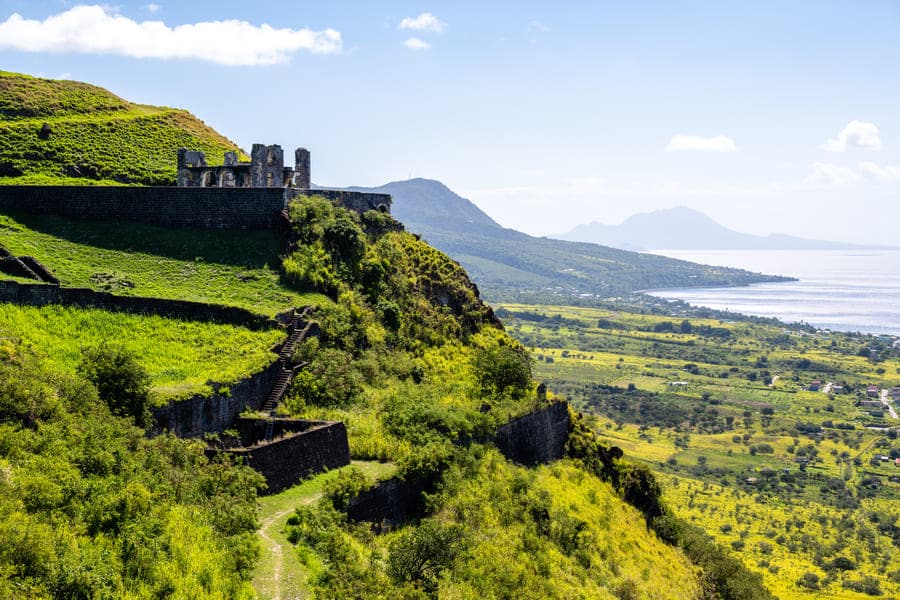
Relocating to St Kitts and Nevis offers a mix of Caribbean charm and practical considerations. Choosing where to live, understanding living costs, and getting to know the climate, healthcare, and transportation are all essential before making the move.
The country consists of two islands: Saint Kitts and Nevis. Basseterre, the capital and largest city located in Saint Kitts, offers historic architecture, modern amenities, and cultural attractions.
Charlestown is the main town on Nevis, known for its colonial buildings, cobbled streets, and harbour.
Frigate Bay, on the southeastern coast of St Kitts, is popular with expatriates and retirees because of its beaches, resorts, golf courses, and easy access to amenities.
Those seeking a quieter lifestyle may prefer the villages around Nevis Peak, which offer a rural setting, a slower pace of life, and proximity to nature.
A single person may need around $1,500 per month for a moderate lifestyle, while a family of four may require at least $2,500.
A one-bedroom apartment costs around $850 per month, while a three-bedroom property may range from $1,500 to 3,500. Monthly utilities are approximately $100.
A basic food basket costs around $60. A meal at an inexpensive restaurant is about $22, while dinner at a mid-range restaurant may cost around $50. A cappuccino is approximately $4.
St Kitts and Nevis has a tropical climate with warm temperatures and abundant sunshine. Average temperatures range from about +24°C in cooler months to +29°C in warmer months.
The wet season lasts from May to November and coincides with the Caribbean hurricane season. The dry season runs from December to April, with lower humidity and less rainfall.
Saint Kitts and Nevis is preparing to introduce National Health Insurance, while public-sector employees and retirees already benefit from a separate government health insurance scheme[6].
Citizens under 18 and over 62 may receive free treatment. The government also subsidises certain services, including chronic disease care.
All people working in the country contribute to the St Kitts and Nevis Social Security Board[7], which offers sickness, maternal, employment injury, and invalidity benefits.
Both public and private healthcare facilities operate in the country. The main public hospitals are Joseph N. France General Hospital in St Kitts and Alexandra Hospital in Nevis. Serious cases may require medical evacuation abroad.
Transport is mainly road-based, and driving is on the left. Roads are generally paved, although some rural routes may be narrow or less well maintained. Car hire and taxi services are available on both islands.
St Kitts has a public bus system, though schedules may vary. Nevis has more limited public transport.
Ferries connect Basseterre and Charlestown. St Kitts is served by Robert L. Bradshaw International Airport, while Nevis is served by Vance W. Amory International Airport.
English is the official language, reflecting the country’s colonial past under British rule. However, Creole is also commonly spoken informally among locals.
Saint Kitts and Nevis's culture is deeply influenced by its African heritage, which is evident in its music, dance, and cuisine. The most famous cultural event is the Carnival, held annually in December and January. It features colourful parades, masquerade bands, and lively street parties.
St Kitts and Nevis has a territorial tax system. Citizenship holders who spend fewer than 183 days a year in the country are generally treated as non-residents and are not subject to taxation there.
The country does not impose personal income tax. However, employees working in the country may be subject to social security contributions and the Housing and Social Development Levy.
St Kitts and Nevis imposes no inheritance, estate, gift, or wealth tax on individuals. The standard corporate income tax rate is 25%[8], while VAT generally applies at a standard rate of 17%[9].
Alongside St Kitts and Nevis, some other Caribbean countries offer citizenship by investment programmes. Among them are:
Caribbean programmes share a number of structural similarities: all require Due Diligence and result in the issuance of a naturalisation certificate — with the passport being a separate subsequent process. However, they have different minimum investments, processing times, and eligibility rules.
| Feature | St Kitts and Nevis | Antigua and Barbuda | Dominica | Grenada | St Lucia |
| Minimum investment | $250,000 | $230,000 | $200,000 | $235,000 | $240,000 |
| Real estate purchase | $325,000+ | $300,000+ | $200,000+ | $270,000+ | $300,000+ |
| Standard processing | 4+ months | 6+ months | 6+ months | 8+ months | 6+ months |
| Property holding period | 7 years | 5 years | 3 or 5 years | 5 years | 5 years |
The programme involves regulatory, documentation, financial, and personal eligibility risks that applicants should assess before proceeding. The most common issues arise from changing rules, incomplete disclosure, source-of-funds evidence, dependant eligibility, and document timing.
Applicants must prove that all investment funds come from legal sources. This may require more than bank statements, particularly where funds come from brokerage accounts, recently established businesses, business sales, or transfers through several jurisdictions.
Applicants with complex financial structures should begin collecting evidence early and prepare a clear financial history covering at least 12 months.
Visa refusals, particularly from the UK or Schengen countries, may receive additional scrutiny during Due Diligence. All refusals must be disclosed and explained. Where possible, applicants may benefit from resolving the issue before submitting a CBI application.
Spouses, children, parents, and other family members must meet the programme’s age, dependency, and financial support requirements. For instance, children over 25, parents under 55, and siblings cannot be included in the application.
Eligibility should be confirmed for each person at the beginning of the process, as an ineligible dependant may require changes to the application or investment strategy.
Property purchased under the programme must generally be held for at least 7 years. This option is therefore more suitable for applicants prepared to retain the investment for the required period.
Starting April 2026, applicants must complete biometric enrolment in person. This can be done in St Kitts and Nevis or at one of the authorised centres in Asia, Europe, the Middle East, or North America. In the United States, for example, the authorised centre is located in Washington, D.C.
Limited locations, expired travel documents, or travel restrictions may create additional costs and delays, so this stage should be planned.

Police certificates, medical records, bank statements, and civil documents may have limited validity periods. For family applications, documents should be collected in the correct order to reduce the risk of expiry before submission.
Professional pre-screening and careful document planning can reduce the likelihood of delays, additional requests, and refusal.
Immigrant Invest is a licensed consulting firm supporting investors applying for citizenship and residence programmes, including the St Kitts and Nevis CBI Programme.
Before submission, our team conducts a confidential preliminary Due Diligence check to identify potential risks such as visa refusals, compliance concerns, or issues with the source of funds. Clients also receive a clear, itemised breakdown of all programme costs.
Immigrant Invest works only with government-approved investment options. For real estate applications, we help select a suitable property and explain deposit and refund conditions in advance, including the use of escrow where applicable.
Our team supports clients throughout the process, from eligibility assessment and route selection to document preparation, biometric procedures, and post-approval formalities. We also provide updates on regulatory changes and detailed guidance on document requirements.
With offices in several countries and a multilingual team, we can assist clients in their preferred language and coordinate applications across jurisdictions.
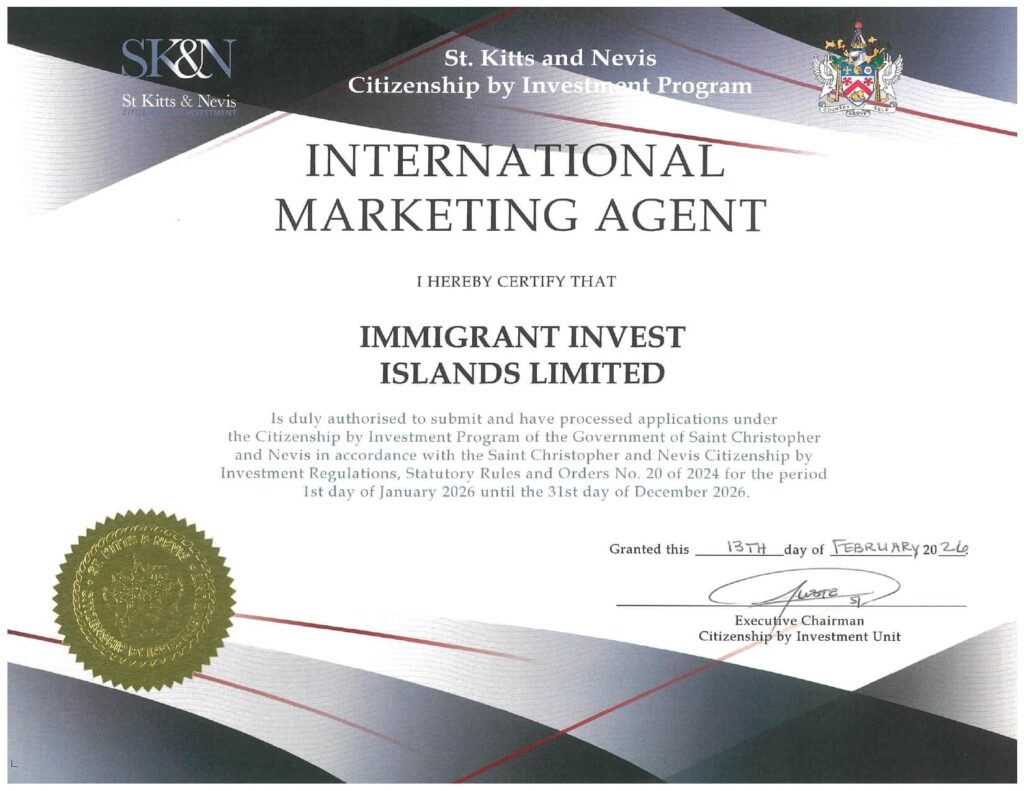
Foreigners can obtain St Kitts and Nevis citizenship by:
Each pathway has its own requirements for potential applicants.
The applicant who decides to obtain St Kitts and Nevis citizenship by investment must contribute at least $250,000 to the country’s economy.
People getting the St Kitts and Nevis passport under other grounds must only pay state fees.
It is hard to say whether St Kitts and Nevis citizenship is worthwhile as it depends on each person’s situation. The country’s passport can be beneficial for several reasons:
No, St Kitts and Nevis and the US are different countries. St Kittians apply for American citizenship under the same rules as other foreigners.
The minimum investment under the St Kitts and Nevis CBI program is $250,000. The applicant pays this sum if they make a non-refundable contribution or support a Public Benefit Project.
A foreigner obtains a St Kitts and Nevis passport:
Citizenship by investment is granted in at least 4 months.
Some benefits of the St Kitts and Nevis passport are:
There is no visa-free agreement between St Kitts and Nevis and the USA. Thus, the St Kittians must get a visa to travel to the US. However, it is possible to obtain such a visa for 10 years.
You can’t work in the UK with a St Kitts and Nevis passport alone. You must obtain a work permit.
Yes, people born in St Kitts and Nevis automatically acquire citizenship by birth.
Yes, St Kitts and Nevis allows dual citizenship, so foreigners don’t need to renounce their other citizenship upon obtaining a St Kitts and Nevis passport.
To qualify for St Kitts and Nevis citizenship by investment, the applicant must contribute at least $250,000 to the country’s economy. This sum is required under the non-refundable contribution and Public Benefit Projects options. It is also possible to buy real estate, in which case the investment sum increases to $325,000.
No mandatory period of residence is currently required before or after obtaining citizenship by investment. However, applicants must attend an approved collection centre to submit their biometrics once the application receives approval in principle.
The government is also evaluating the possible introduction of a physical presence requirement, so applicants should confirm the rules in force when applying.
If the investor’s application is refused, the citizenship is not granted. The investor does not lose the qualifying investment, as it is normally made only after approval in principle, but application, Due Diligence, and other administrative fees paid before the decision are non-refundable.
Yes, the main applicant may include a spouse, children under 18, financially dependent students aged 18 to 25, dependent adult children with physical or mental challenges, and supported parents aged 55 or over.
Obtaining citizenship does not automatically change tax obligations elsewhere. These usually depend on tax residence, income sources, and the laws of each country. Some countries also tax citizens living abroad, including the United States. Applicants should obtain advice based on their individual tax position.