

Offices worldwide
October 15, 2025
Reading time: 9 min

Gateway to the tropics: all ways to get St Lucia second passport

St Lucia citizenship offers numerous benefits, such as increased global mobility, tax optimisation, or obtaining visitor visas for the US. The most popular option to become a St Lucian citizen is to invest at least $100,000 in the country’s economy.

Other methods include descent, marriage, and naturalisation. The article explores how foreigners can acquire citizenship in this Caribbean country.

Lyle Julien
Lyle Julien
Listed all the ways to get a St Lucia passport
Fact checked by Elena RudaElena Ruda
Elena Ruda
Fact checked by Elena Ruda
Elena helped over 500 investors’ families to choose and obtain second citizenship or residency. She knows the pros and cons of each investment option and improves the industry expertise at the company.
Reviewed by Vladlena BaranovaVladlena Baranova
Vladlena Baranova
Reviewed by Vladlena Baranova
Vladlena leads preparation to Due Diligence and application for citizenship or residency by investment. She performs independent and in-depth analysis of investors’ situations and indicates possible risks. Vladlena helped to get second passports and residence permits to over 300 investors from all over the world.
How to get citizenship in St Lucia

St Lucia citizenship overview

A foreigner can obtain St Lucia citizenship on five grounds:

  • birth — if a person is born in St Lucia;
  • descent — if the person has a parent who is St Lucian;
  • marriage — if they are married to a St Lucia national;
  • naturalisation — if they have lived in the country for at least 7 years;
  • investment — if they have contributed at least $100,000 in the country’s economy.

Investment is the most popular path to a St Lucia passport. It is also the fastest one, as the investor can get citizenship in just six months.

St Lucia citizenship by investment

Foreigners have four investment options to choose from:

  • non-refundable contribution; 
  • real estate purchase;
  • purchase of government bonds;
  • business investment.

The minimum investment amount varies depending on the chosen option. Currently, it is $100,000, but this threshold will increase to $200,000, supposedly, by June 30, 2024, or later this year.

Non-refundable contribution — at least $100,000. The investor contributes to the National Economic Fund, which allocates funds to develop healthcare, alternative energy, education, and infrastructure.

The required investment sum depends on the composition of the investor’s family. While a single applicant must invest $100,000+, a married couple is required to pay $140,000+, and a family of four must contribute $150,000+.

The investor cannot reclaim the money contributed under this option.

Real estate purchase — at least $200,000. The investor buys a property or shares in government-approved projects, which may include hotels, resorts, marinas, apartments, and villas. It is mandatory to retain ownership of the property for at least five years, after which it may be sold.

The purchased property can be rented out, with the investor potentially earning an annual return of 2—5%.

The sum required does not depend on the family composition.

Examples of real estate available for investors

Gateway to the tropics: exploring all ways to get St Lucia second passport
St. Lucia, Vieux Fort
$318,000+
Apartments and commercial units in a large resort project
20 m² — 134 m²
1—2
1—2
Gateway to the tropics: exploring all ways to get St Lucia second passport
St. Lucia, Micoud
$3,000,000+
Luxurious villa with panoramic ocean and island views
929 m²
10
10

Purchase of government bonds — at least $300,000. They must be non-interest-bearing. The investor can redeem bonds in five years and recover their money. The required sum doesn’t depend on the family composition.

Business investment — at least $100,000. The investor contributes money to government-approved business projects such as restaurants, cruise ports, marinas, bridges, roads, pharmaceuticals, and research facilities.

Applicants who support projects developing the country’s infrastructure can invest $100,000 if they apply alone. The sum increases to $150,000 if up to four family members join the investor.

If the project doesn’t enhance St Lucian infrastructure, the applicant must contribute at least $3,500,000. There is also the possibility of making a collective investment. In this case, a group of investors pays $6,000,000, each contributing at least $1,000,000.

Requirements for investors 

Besides investing, the foreigner must also meet specific criteria and gather documents for the Due Diligence check by the Saint Lucia Citizenship by Investment Unit.

Eligibility criteria. The investor must:

  • be over 18;
  • have no criminal record and no visa refusals;
  • have a legal source of income and be able to prove it.

Family inclusion. When applying, the investor can add their close family members, including a spouse, children under 30, parents over 55, and minor siblings.

Close family members must meet specific requirements: children and parents must be financially dependent on the investor, and siblings must have parental consent, be unmarried, and have no children of their own. There are no specific requirements for spouses.

Documents. The basic list of documents the investor provides includes:

  • application form;
  • detailed CV;
  • all valid passports;
  • birth certificate;
  • all degrees, diplomas or higher education certificates received;
  • bank statements for the last 6 months and recommendations from banks;
  • proof of source of income;
  • certificate of no criminal record;
  • proof of residence address;
  • marriage certificate, if applicable;

The St Lucia authorities can request additional documents.

How to get Saint Lucia citizenship by investment: a step-by-step procedure

Let's consider the procedure for obtaining citizenship through the option of purchasing real estate. The process takes at least six months and is completely remote. Investors don’t need to visit the island at any stage, as everything is done through the licensed agent.

How to get Saint Lucia citizenship by investment: a step-by-step procedure
Let's consider the procedure for obtaining citizenship through the option of purchasing real estate. The process takes at least six months and is completely remote. Investors don’t need to visit the island at any stage, as everything is done through the licensed agent.
PT8M
1 day
Preliminary Due Diligence
Before starting the St Lucia citizenship application process, we conduct preliminary Due Diligence, checking the investor against international databases and on the Internet. This allows us to understand the applicant’s background and decrease the risk of refusal to 1%. If issues arise, we offer solutions, such as choosing another program or preparing additional documents. After successful Due Diligence, we sign a contract with the investor.
2—5 weeks
Collection of documents
Immigrant Invest compiles a list of documents that the investor must prepare. Then, the lawyers help to notarise, apostille, and translate them. They also fill out government forms.
4—5 months
Main Due Diligence
Main Due Diligence
The St Lucia CBI Unit accepts the documents and conducts Due Diligence. The process is fully remote and takes at least four months.
1 day
Interview
Interview
During the Due Diligence process, all applicants over 16 undergo an interview, either in person or via video call. It can be conducted in English or the investor's native language.
Up to 90 days
Purchase of real estate
The investor only purchases real estate after the application is approved. They have 90 days to do so.
Up to 6 weeks
Obtainment of a naturalisation certificate and a passport
Investors receive their documents at an Immigrant Invest office or have them delivered by courier to their chosen address. They do not need to come to St Lucia after completing the process.

St Lucia citizenship by descent and birth

Eligibility criteria. A child born on the territory of St Lucia obtains the country’s citizenship automatically, by the right of soil. A person born outside St Lucia can become a citizen, provided at least one of their parents is a St Lucian national.

Adopted children under 21 also obtain citizenship if at least one of the adoptive parents is a St Lucian national.

The application is filed with the Citizenship Unit of the Ministry of Home Affairs in St Lucia. 

Documents. Individuals obtaining passports by descent must provide an application form, a police certificate of character, two references from respected individuals or organisations that can attest to the applicant's good character, and passport-size photos. St Lucian ancestry is proven by submitting a birth certificate with the names of the parents stated on it.

Adopted individuals must provide an adoption certificate instead of a birth one.

St Lucia citizenship by marriage

Eligibility criteria. Citizenship by marriage can be obtained by a foreigner married to a St Lucia national or a person who has been a St Lucia citizen at some point during their marriage.

Here are some of the requirements an applicant must meet:

  • be of good character;
  • speak English;
  • not be a threat to the security or public order of St Lucia;
  • not be convicted of a criminal offence that is punishable by imprisonment for six months or more;
  • not be convicted of any offence relating to dangerous drugs.

Documents. The package of documents the applicant must provide includes an application form, passport photos, a police certificate of character, proof of fulfilment of income tax obligations, and two references from respected individuals or organisations.

The person submits documents to the Citizenship Unit of the Ministry of Home Affairs in St Lucia to obtain citizenship by marriage.

Fees. Upon applying for citizenship, the foreigner pays for the granting of the citizenship certificate and for processing the application. The cost of the certificate depends on the nationality of the person:

  • $2,000 — for Caribbean Community nationals;
  • $3,000 — for Commonwealth nationals;
  • $5,000 — for nationals of other countries.

The application processing fee is $75.

St Lucia citizenship by naturalisation

Eligibility criteria. Foreigners obtain citizenship by naturalisation if they have lived in the country for at least seven years and for at least 12 months immediately before applying for St Lucia citizenship. They must also have an intention to continue residing in the country.

A person is not required to live in the country for the entire period if they have served under the government or have partially resided and served for not less than seven years.

Commonwealth citizens are not required to fulfil the 12-month residence requirement.

Other requirements include being of good character and having adequate knowledge of English and the duties of St Lucian citizens.

Documents. The applicant for citizenship by naturalisation must submit an application form, three passport-size photos, a police clearance certificate, proof of fulfilment of income tax obligations, and two references from respected individuals or organisations.

Process. The process of obtaining citizenship by naturalisation consists of the following steps:

  1. Obtain the right to reside in St Lucia and live there continuously.
  2. Apply for permanent residence five years later and reside with it for two years.
  3. Collect documents and submit them to the Citizenship Unit of the Ministry of Home Affairs in St Lucia.
  4. Pay the fees.
  5. Wait for the decision.
  6. Take the Oath of Allegiance.
  7. Collect the certificate of naturalisation.

Fees. The foreigner pays $5,000 for a Certificate of Naturalisation and $75 for application processing.

How to get and restore a St Lucian passport

Documents required for obtaining a passport:

  • national identification card;
  • birth certificate;
  • Saint Lucia citizenship document, if born overseas;
  • marriage certificate — for women only, if applicable.

Application process. To get a passport, a new St Lucia citizen must undergo several steps:

  1. Complete the passport application form. 
  2. Pay a fee: $30 for a regular process and $48 for an express procedure. 
  3. Submit documents to the Immigration Department.
  4. When collecting the passport, present the receipt of payment. 

If a person other than the applicant will be collecting the passport, the person's details must be included on the form.

The issuance of the document takes 14 days for a regular passport and 1—5 days for an express one.

To replace or restore a passport, the person undergoes similar steps. In this case, the fee is $74.

Deprivation, renunciation, and reacquisition of citizenship

Deprivation. St Lucia citizens can be deprived of their citizenship in several cases:

  • citizenship was obtained by fraud, false representation, or concealment;
  • the citizen was disloyal or disaffected towards St Lucia;
  • the citizen cooperated with the enemy in the event of a war between St Lucia and another country.

Citizenship by birth or descent cannot be deprived.

Renunciation. Any national can renounce St Lucia citizenship if they plan to obtain citizenship in another country. To do this, they file a declaration with the Ministry of Home Affairs.

Reacquisition. It is possible to reacquire citizenship that was previously renounced. The individual must file an application for registration as a citizen.

7 benefits of St Lucia citizenship

1. Visitor visa to the US. St Lucians can obtain a US visa valid for 10 years immediately. The application is filed at the nearest consulate and is considered within as little as two weeks.

2. Increased global mobility. St Lucia passport holders can enter many countries without visas.

Some destinations require St Lucians to get an Electronic Travel Authorization (eTA) or a visa upon arrival, which can be prepared in as little as several minutes. These procedures are significantly quicker than the traditional visa process and can be completed in just a few minutes.

3. Dual citizenship. St Lucia recognises dual citizenship. Therefore, foreigners applying for a St Lucian passport do not need to renounce their other citizenship. This only applies to citizens of countries that allow two or more passports.

4. Attractive tax system. There are no taxes on wealth, inheritance, or capital gains. Personal and corporate income is taxed only if it is earned within the country.

5. Opening international bank accounts. St Lucian passport holders can open bank accounts in European banks to take loans, keep money in deposits, or make transactions. The process might be easier for them and require less documentation than for foreigners with other citizenships.

6. Opportunities for businesses. Entrepreneurs can register companies in St Lucia and, at the same time, keep their personal information private as it does not enter the commercial registry.

Owners of St Lucian companies can expand their businesses within the Caribbean Community states as they have a unified market. This allows for a free flow of money, goods, and labour. 

Having European bank accounts also facilitates international cooperation between companies registered in St Lucia and those in Europe or America.

7. Creation of a safe haven. St Lucian citizens can enter the country under any circumstances and spend as much time there as they wish. This is helpful in the event of any instabilities in the person’s other country of residence.

St Lucia might also be a perfect destination for holidays and retirement, due to its peacefulness, closeness to nature, and pleasant climate.

How to obtain St Lucia citizenship
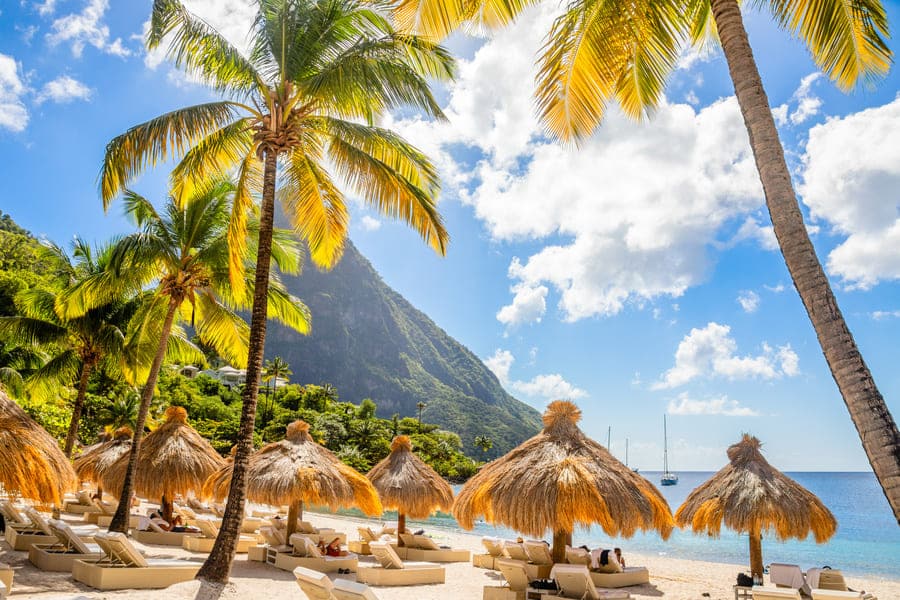
Sugar Beach in St Lucia. February to May are considered the best months for holidays in St Lucia

What to know before moving to St Lucia

Climate. The average temperature on the island ranges from 23°C to 30°C (73–86°F). The warmest month is November; the coldest is January, but even during this month, the air temperature usually doesn’t drop below 20°C (68°F). The water temperature varies from 25°C to 29°C (77—84°F) throughout the year.

The rainy season lasts from mid-June to November; during the other months, the sun shines most of the time. St Lucia can be affected by hurricanes, which mostly occur from August to October.

The cost of living in St Lucia is generally lower than in the UK or the US. A single person requires around $1,500 per month to maintain a moderate lifestyle, and a family of four would need around $3,000 to $4,000. In comparison, an individual in the US needs a minimum of $2,500, while in the UK, they require $2,000. 

The rent for a one-bedroom apartment in St Lucia costs $350 to $500, depending on the location. One pays $650 to $900 for a three-bedroom apartment. Monthly utilities cost around $100.

The food basket, consisting of a litre of milk, white bread, a kilogram of rice, chicken and beef, 12 eggs, and some fruit and vegetables, costs around $55. The price for a cup of coffee is $3, and a meal in an inexpensive restaurant is $7.

Healthcare in Saint Lucia is of high quality and meets British standards. There are public and private clinics, but expats usually use private ones.

The National Insurance Corporation functions in St Lucia. Citizens registered with it can access sickness, hospitalisation, maternity, and employment injury benefits to get discounts on treatment.

Hospitals and clinics in St Lucia can deal with most health problems, but severe cases might require immediate evacuation. Some of the medical facilities in the country are Victoria Hospital, Tapion Hospital, and St Jude’s Hospital in SLCA. Mental health problems can be treated at the St Lucia National Mental Wellness Center.

Language and culture. Saint Lucia boasts a vibrant and diverse culture, largely influenced by African, French, and British heritage. English is the official language, and most people speak it. French Creole is also common.

Christianity is the predominant religion, with a majority of the population identifying as Roman Catholic, followed by Protestant denominations. Around 2% identify as members of the Rastafari movement.

Many carnivals and festivals occur in St Lucia, the most famous being the Saint Lucia Jazz & Arts Festival. Another significant celebration is the Saint Lucia Carnival, held in July, featuring vibrant costumes, parades, and calypso music competitions.

Saint Lucian food is a flavourful mix of Creole with French and British influences.

5 places to live in St Lucia

1. Castries is the capital of Saint Lucia and the largest city in the country. It is home to government offices, shopping centres, and several schools. The area offers various housing options, from upscale apartments to more modest local homes. Living in Castries allows for easy access to the rest of the island.

2. Rodney Bay is located in the Gros Islet district, known for its beautiful beaches and vibrant nightlife. It is a popular area for expatriates and tourists, featuring many restaurants, bars, and shops. The Rodney Bay Marina is a significant attraction, offering mooring for boats and yachts.

3. Cap Estate, also in the Gros Islet district, is known for its luxury homes and exclusive neighbourhoods. It is a quiet area, perfect for those seeking privacy and tranquillity. Many homes in Cap Estate offer stunning ocean views and access to golf courses, making it a preferred location for the affluent.

4. Soufrière. Those who prefer to be closer to nature might find Soufrière appealing. It is located near the Pitons, two volcanic spires that are a UNESCO World Heritage Site. Soufrière has a laid-back vibe and is close to some of the island's best natural attractions, including hot springs, waterfalls, and hiking trails.

5. Vieux Fort. Located on the island’s southern tip, Vieux Fort is known for its less crowded beaches and is close to the Hewanorra International Airport. The area offers residential and commercial properties with relatively lower living costs than the more tourist-heavy north.

Visa-free countries for St Lucia passport holders

St Lucian citizens enjoy visa-free travel to various destinations, including the Schengen states, the UK, South Korea, and numerous Caribbean states like St Kitts and Nevis, Dominica, and Grenada.

However, while St Lucians can enter these countries without a visa, their stay is typically limited, varying depending on the destination.

Visa-free countries and conditions for entering them

Country Region Condition of entry
Albania Europe eTA
Andorra Europe Visa-free
Angola Africa Visa-free
Antigua and Barbuda The Caribbean Visa-free
Argentina South America Visa-free
Armenia Middle East eTA
Australia Oceania eTA
Austria Europe Visa-free
Bahamas The Caribbean Visa-free
Bahrain Middle East eTA
Bangladesh Asia Visa upon arrival
Barbados The Caribbean Visa-free
Belgium Europe Visa-free
Belize Central America Visa-free
Benin Africa eTA
Bhutan Asia eTA
Bolivia South America Visa upon arrival
Bosnia and Herzegovina Europe Visa-free
Botswana Africa Visa-free
Bulgaria Europe Visa-free
Burkina Faso Africa eTA
Burundi Africa Visa upon arrival
Cambodia Asia Visa upon arrival
Cameroon Africa eTA
Cape Verde Africa Visa upon arrival
Chile South America Visa-free
Colombia South America Visa-free
Comoros Africa Visa upon arrival
Congo-Kinshasa Africa eTA
Costa Rica Central America Visa-free
Croatia Europe Visa-free
Cuba The Caribbean Visa-free
Cyprus Europe Visa-free
Czechia Europe Visa-free
Côte d’Ivoire Africa eTA
Denmark Europe Visa-free
Djibouti Africa eTA
Dominica The Caribbean Visa-free
Dominican Republic The Caribbean Visa-free
Ecuador South America Visa-free
Egypt Middle East Visa upon arrival
El Salvador Central America Visa-free
Equatorial Guinea Africa eTA
Estonia Europe Visa-free
Eswatini Africa Visa-free
Ethiopia Africa eTA
Fiji Oceania Visa-free
Finland Europe Visa-free
France Europe Visa-free
Gabon Africa eTA
Gambia Africa Visa-free
Georgia Europe eTA
Germany Europe Visa-free
Greece Europe Visa-free
Grenada The Caribbean Visa-free
Guatemala Central America Visa-free
Guinea Africa eTA
Guinea-Bissau Africa Visa upon arrival
Guyana South America Visa-free
Haiti The Caribbean Visa-free
Honduras Central America Visa-free
Hungary Europe Visa-free
Iceland Europe Visa-free
India Asia eTA
Iran Middle East eTA
Ireland Europe Visa-free
Israel Middle East Visa-free
Italy Europe Visa-free
Jamaica The Caribbean Visa-free
Jordan Middle East Visa upon arrival
Kazakhstan Asia eTA
Kenya Africa Visa-free
Kiribati Oceania Visa-free
Kyrgyzstan Asia eTA
Laos Asia Visa upon arrival
Latvia Europe Visa-free
Lesotho Africa Visa-free
Liechtenstein Europe Visa-free
Lithuania Europe Visa-free
Luxembourg Europe Visa-free
Madagascar Africa Visa upon arrival
Malawi Africa Visa-free
Malaysia Asia Visa-free
Maldives Asia Visa upon arrival
Malta Europe Visa-free
Mauritania Africa Visa upon arrival
Mauritius Africa Visa-free
Micronesia Oceania Visa-free
Moldova Europe Visa-free
Monaco Europe Visa-free
Mongolia Asia eTA
Montenegro Europe Visa-free
Mozambique Africa Visa upon arrival
Nepal Asia Visa upon arrival
Netherlands Europe Visa-free
Nicaragua Central America Visa-free
Nigeria Africa eTA
Norway Europe Visa-free
Oman Middle East eTA
Pakistan Middle East eTA
Palau Oceania Visa upon arrival
Panama Central America Visa-free
Papua New Guinea Oceania eTA
Peru South America Visa-free
Philippines Asia Visa-free
Poland Europe Visa-free
Portugal Europe Visa-free
Romania Europe Visa-free
Rwanda Africa Visa upon arrival
Samoa Oceania Visa upon arrival
San Marino Europe Visa-free
Senegal Africa Visa upon arrival
Seychelles Africa Visa-free
Sierra Leone Africa Visa upon arrival
Singapore Asia Visa-free
Slovakia Europe Visa-free
Slovenia Europe Visa-free
Solomon Islands Oceania Visa upon arrival
Somalia Africa Visa upon arrival
South Korea Asia eTA
South Sudan Africa eTA
Spain Europe Visa-free
Sri Lanka Asia eTA
St Kitts and Nevis The Caribbean Visa-free
St Vincent and Grenadines The Caribbean Visa-free
Suriname South America Visa-free
Sweden Europe Visa-free
Switzerland Europe Visa-free
São Tomé and Príncipe Africa eTA
Tajikistan Asia eTA
Tanzania Africa Visa-free
Thailand Asia eTA
Timor-Leste Asia Visa upon arrival
Togo Africa Visa upon arrival
Tonga Oceania Visa upon arrival
Trinidad and Tobago The Caribbean Visa-free
Tunisia Africa Visa-free
Turkey Europe Visa upon arrival
Tuvalu Oceania Visa upon arrival
Uganda Africa eTA
United Kingdom Europe Visa-free
Uzbekistan Asia Visa-free
Vanuatu Oceania Visa-free
Venezuela South America Visa-free
Vietnam Asia eTA
Zambia Africa Visa-free
Zimbabwe Africa Visa-free
Expand the table Collapse the table

Key takeaways: how to get St Lucia citizenship

  1. Foreigners obtain St Lucia citizenship by descent, marriage, naturalisation, or investment.
  2. The path to citizenship by naturalisation takes at least seven years.
  3. Citizenship by investment can be obtained in at least six months with a contribution of at least $100,000 to the country’s economy.
  4. Benefits of St Lucia citizenship include increased global mobility, a visitor visa for the US valid for ten years, tax optimisation, the opportunity to open international bank accounts and expand businesses, and the creation of a safe haven.
  5. St Lucia allows its citizens to hold dual or multiple citizenship. 

Frequently asked questions

How do you become a citizen of St Lucia?

There are four primary ways to become a St Lucia citizen:

  • descent;
  • marriage;
  • naturalisation;
  • investment.

Participating in the St Lucia Citizenship by Investment Program is the fastest and easiest way. Under it, a foreigner invests $100,000+ in the country’s economy and receives a passport in just over six months.
Is St Lucia citizenship worth it?

Whether St Lucia citizenship is worth it depends on the specific needs of the individual. It might be beneficial for several reasons:

  • increased global mobility;
  • visitor visa for the US valid for ten years;
  • tax optimisation;
  • the opportunity to open international bank accounts and expand business;
  • the right to have dual citizenship;
  • the creation of a safe haven.

Another advantage is the opportunity to get St Lucia citizenship by investing $100,000 or more in the country’s economy.

How long does it take to get citizenship in St Lucia by investment?

Obtaining St Lucia citizenship by investment takes at least six months. The process includes signing an agreement with Immigrant Invest, collecting documents, undergoing Due Diligence by St Lucia Citizenship by Investment Unit, and fulfilling investment requirements.

How much does St Lucia citizenship cost?

If a foreigner wishes to obtain St Lucia citizenship by investment, they must invest at least $100,000. Additional expenses include Due Diligence and administrative fees

When obtaining citizenship by marriage, persons pay between $2,000 and $5,000; when getting citizenship by naturalisation, they pay $5,000. An additional processing fee of $75 also applies.

Can I get dual citizenship in St Lucia?

Yes, St Lucia allows its citizens to have dual citizenship. However, only individuals from countries that recognise dual citizenship can retain their original citizenship when obtaining a St Lucia passport.

How much does it cost to get a Caribbean passport?

To obtain St Lucia citizenship by investment, the foreigner must contribute at least $100,000 to the country’s economy.

Other Caribbean states also offer foreigners the opportunity to get their passports by investment. The minimum sums are:

How to get citizenship in St Lucia by marriage?

Foreigners can obtain St Lucia citizenship if they are married to a national of the country. The application for a passport is filed with the Citizenship Unit of the Ministry of Home Affairs. 

Applicants must meet the following requirements:

  • be of a good character;
  • speak English;
  • not be a threat to the security or public order of St Lucia.
  • not be convicted of a criminal offence punishable by imprisonment for six months or more;
  • not be convicted of any offence relating to dangerous drugs.

Do St Lucians have British citizenship?

No, St Lucians are not British citizens. They are eligible to apply for UK citizenship on preferential terms if all the following requirements are met:

  • at least one of their parents had arrived in the UK before 1973;
  • they have lived in the UK and have not been away from it for more than two years;
  • either they were born in the UK or had arrived there before turning 18.

In other cases, St Lucians undergo the same process as other foreigners who want to get British citizenship.

How do you qualify for CIP in St Lucia?

To qualify for CIP, or Citizenship by Investment Program, one must invest at least $100,000 in the country’s economy. They must also meet several requirements:

  • be over 18;
  • have no criminal record and no visa refusals;
  • have a legal source of income and be able to prove it;
  • undergo a Due Diligence check by the St Lucia CBI Unit.

How to apply for St Lucia citizenship by descent?

Foreigners can apply for citizenship by descent if at least one of their parents is a St Lucian national. They file an application with the Citizenship Unit of the Ministry of Home Affairs and prove their connection to St Lucia with a birth certificate.

Gateway to the tropics: all ways to get St Lucia second passport
Share:
Home Caribbean citizenship by investment: how to choose a program
Gateway to the tropics: all ways to get St Lucia second passport
Scroll to Top