What is Caribbean citizenship by investment?
Caribbean citizenship by investment refers to programmes that allow high-net-worth individuals from anywhere in the world to acquire a second citizenship in select Caribbean countries. These countries include St Kitts and Nevis, Grenada, Antigua and Barbuda, St Lucia, and Dominica.
Investors usually choose between two main routes: making a non-refundable contribution to a state fund or purchasing government-approved real estate. Some countries also offer additional options, such as investing in bonds, business projects or public benefit initiatives.
To apply for Caribbean citizenship by investment, applicants must first pass a Due Diligence check, which usually includes background screening, verification of the source of funds, and checks against international databases. Only after approval can the investor complete the required contribution or investment and receive citizenship.
Visa-free countries for Caribbean citizens
Investors often choose Caribbean citizenship for greater travel freedom. A Caribbean citizenship by investment comparison should therefore focus not only on the number of visa-free destinations, but also on whether each passport gives access to the countries the investor and their family visit most often.
Visa access to popular travel destinations with a Caribbean passport
|
Destination country
|
St Kitts and Nevis
|
Antigua and Barbuda
|
Grenada
|
St Lucia
|
Dominica
|
|
Europe
|
|||||
|
Andorra
|
Visa-free
|
Visa-free
|
Visa-free
|
Visa-free
|
Visa-free
|
|
Austria
|
Visa-free
|
Visa-free
|
Visa-free
|
Visa-free
|
Visa-free
|
|
Belgium
|
Visa-free
|
Visa-free
|
Visa-free
|
Visa-free
|
Visa-free
|
|
France
|
Visa-free
|
Visa-free
|
Visa-free
|
Visa-free
|
Visa-free
|
|
Germany
|
Visa-free
|
Visa-free
|
Visa-free
|
Visa-free
|
Visa-free
|
|
Greece
|
Visa-free
|
Visa-free
|
Visa-free
|
Visa-free
|
Visa-free
|
|
Italy
|
Visa-free
|
Visa-free
|
Visa-free
|
Visa-free
|
Visa-free
|
|
Netherlands
|
Visa-free
|
Visa-free
|
Visa-free
|
Visa-free
|
Visa-free
|
|
Portugal
|
Visa-free
|
Visa-free
|
Visa-free
|
Visa-free
|
Visa-free
|
|
Spain
|
Visa-free
|
Visa-free
|
Visa-free
|
Visa-free
|
Visa-free
|
|
Switzerland
|
Visa-free
|
Visa-free
|
Visa-free
|
Visa-free
|
Visa-free
|
|
Türkiye
|
Visa-free
|
ETA or visa on arrival
|
ETA or visa on arrival
|
ETA or visa on arrival
|
ETA or visa on arrival
|
|
United Kingdom
|
ETA or visa on arrival
|
ETA or visa on arrival
|
ETA or visa on arrival
|
Visa required
|
Visa required
|
|
Ireland
|
Visa required
|
Visa-free
|
Visa-free
|
Visa required
|
Visa required
|
|
Americas
|
|||||
|
United States
|
Visa required
|
Visa required
|
Visa required
|
Visa required
|
Visa required
|
|
Canada
|
Visa required
|
Visa required
|
Visa required
|
Visa required
|
Visa required
|
|
Mexico
|
Visa required
|
Visa required
|
Visa required
|
Visa required
|
Visa required
|
|
Brazil
|
Visa-free
|
Visa-free
|
Visa-free
|
Visa-free
|
Visa-free
|
|
Asia
|
|||||
|
United Arab Emirates
|
Visa required
|
Visa required
|
Visa required
|
Visa required
|
Visa required
|
|
Qatar
|
ETA or visa on arrival
|
ETA or visa on arrival
|
ETA or visa on arrival
|
ETA or visa on arrival
|
ETA or visa on arrival
|
|
Singapore
|
Visa-free
|
Visa-free
|
Visa-free
|
Visa-free
|
Visa-free
|
|
Hong Kong
|
Visa-free
|
Visa-free
|
Visa-free
|
Visa-free
|
Visa-free
|
|
Japan
|
Visa required
|
Visa required
|
Visa required
|
Visa required
|
Visa required
|
|
China
|
Visa required
|
Visa-free
|
Visa-free
|
Visa required
|
Visa-free
|
|
Thailand
|
Visa required
|
Visa required
|
Visa required
|
Visa required
|
Visa required
|
|
India
|
ETA or visa on arrival
|
ETA or visa on arrival
|
ETA or visa on arrival
|
ETA or visa on arrival
|
ETA or visa on arrival
|
|
Maldives
|
ETA or visa on arrival
|
ETA or visa on arrival
|
ETA or visa on arrival
|
ETA or visa on arrival
|
ETA or visa on arrival
|
|
Africa
|
|||||
|
South Africa
|
Visa required
|
Visa-free
|
Visa required
|
Visa required
|
Visa required
|
|
Egypt
|
Visa required
|
Visa required
|
Visa required
|
Visa required
|
Visa required
|
|
Mauritius
|
Visa-free
|
Visa-free
|
Visa-free
|
Visa-free
|
Visa-free
|
|
Seychelles
|
ETA or visa on arrival
|
ETA or visa on arrival
|
ETA or visa on arrival
|
ETA or visa on arrival
|
ETA or visa on arrival
|
|
Kenya
|
ETA or visa on arrival
|
ETA or visa on arrival
|
ETA or visa on arrival
|
ETA or visa on arrival
|
ETA or visa on arrival
|
|
Tanzania
|
Visa-free
|
Visa-free
|
Visa-free
|
Visa-free
|
Visa-free
|
|
Oceania
|
|||||
|
Australia
|
Visa required
|
Visa required
|
Visa required
|
Visa required
|
Visa required
|
|
New Zealand
|
Visa required
|
Visa required
|
Visa required
|
Visa required
|
Visa required
|
|
Fiji
|
Visa-free
|
Visa-free
|
Visa-free
|
Visa-free
|
Visa-free
|
|
Samoa
|
ETA or visa on arrival
|
ETA or visa on arrival
|
ETA or visa on arrival
|
ETA or visa on arrival
|
ETA or visa on arrival
|
Europe and the UK
Citizens of Antigua and Barbuda, Dominica, Grenada, St Kitts and Nevis, and St Lucia can travel to the Schengen Area without a visa for short stays of up to 90 days in any 180-day period.
Access to the UK varies by country. Citizens of Antigua and Barbuda, Grenada, and St Kitts and Nevis can visit the UK with an electronic travel authorisation, which is much simpler to obtain than a regular visa. Citizens of Dominica and St Lucia must obtain a UK visa before travelling.
Popular destinations in Asia
Caribbean passports by investment also provide visa-free access to Hong Kong and Singapore, although the permitted length of stay depends on the destination. For example, Hong Kong allows citizens of the five Caribbean countries to stay visa-free for up to 90 days.
In Singapore, the final length of stay is determined by immigration officers at the checkpoint.
Grenada and Dominica passports also allow visa-free travel to China for up to 30 days. The rule applies to ordinary passport holders under China’s mutual visa exemption agreements with these countries.
The United States
Citizens of Caribbean countries are required to obtain visas to visit the US — but that does not mean that a Caribbean passport won’t be useful for investors who want to travel to the country.
Citizens of some Caribbean countries can apply for long-term US visitor visas.
Citizens of Grenada, St Kitts and Nevis, and St Lucia may be issued multiple-entry B-1/B-2 visitor visas valid for up to 10 years. This visa allows temporary travel to the United States for business, tourism, medical treatment, or a combination of these purposes. It does not give the right to live or work in the country permanently.
For Antigua and Barbuda and Dominica citizens, the rules are different: they may obtain B-1/B-2 visas as single-entry visas valid for 3 months.
Grenada citizenship stands out because its citizens are eligible to apply for the US E-2 Treaty Investor visa. The E-2 visa is for nationals of treaty countries who invest a substantial amount of capital in a real operating business in the United States and come to develop and direct that business.
US law does not set a fixed minimum investment amount, but the funds must be substantial and committed to the enterprise. Investors often consider projects starting at $200,000, although the required amount depends on the type and scale of the business.
5 benefits of a Caribbean passport
Apart from visa-free travel, Caribbean citizenship may offer investors and their families more flexibility in everyday life, business, banking, tax planning, and long-term security. The exact benefits depend on the country, the investor’s tax residence, and the rules of their first country of citizenship.
1. No need to relocate to the Caribbean
Caribbean citizenship by investment does not oblige one to move to the Caribbean full-time. None of the countries requires investors to spend any substantial amount of time, but some states have short visit requirements or plan to implement those in the future.
Antigua and Barbuda requires investors to spend at least 5 days in the country within the first 5 years after obtaining citizenship. Otherwise, citizenship may be deprived and the investment is not refunded[1].
St Kitts and Nevis citizenship acquisition process involves submission of biometrics at authorised centres. Aside from St Kitts itself, submission centres are located in the UK, Canada, the UAE, China, Turkey, Morocco, and Taiwan[2].
Dominica has announced plans to require successful CBI applicants to visit the country and collect their passports in person[3].
2. Smart Plan B for the whole family
A Caribbean passport can work as a long-term Plan B: it gives the investor and their family members the right to live in another country if they ever need a safe alternative. This is different from relying on a study visa or a temporary residence permit abroad, which usually depends on employment, income, or renewal rules.
For children, a second citizenship can provide more than travel convenience. It may offer a secure place to live, study, and build a future if circumstances change in the family’s country of residence.
3. Opportunity to expand business into the CARICOM market
A Caribbean passport may make it easier for entrepreneurs to explore business opportunities in the CARICOM market. Antigua and Barbuda, Dominica, Grenada, St Kitts and Nevis, and St Lucia are full CARICOM member states[4].
CARICOM works through the Caribbean Single Market and Economy, which aims to create a single economic space for participating member states. Its framework covers the free movement of goods, services, capital, skilled nationals, and the right of establishment.
For business owners, the right of establishment is especially relevant. It allows CARICOM nationals to set up and operate a business in another participating member state[5]. This may give Caribbean citizens a convenient starting point for regional expansion.
4. Tax planning opportunities
None of the five Caribbean countries imposes wealth, capital gains, inheritance, or gift tax on individuals. In addition, Antigua and Barbuda and St Kitts and Nevis do not impose personal income tax on individuals.
In all five countries, investors generally won’t have to pay tax on their worldwide income simply because they obtain citizenship. Tax obligations may arise if they become tax residents, earn money within the country, own taxable local assets, or carry out business there.
5. Dual citizenship is allowed
The five Caribbean CBI countries allow investors to keep their first citizenship while acquiring a Caribbean one.
People who obtain citizenship by investment in these states won’t have to renounce their original nationality, unless their country of origin requires it.
3 myths about Caribbean citizenship programmes
Caribbean citizenship by investment is often surrounded by misconceptions, especially around how quickly the process works and what investors are expected to do.
Understanding these points helps applicants assess the programmes realistically and avoid costly mistakes.
1. Caribbean citizenship can simply be bought
This is not correct. Citizenship by investment is a regulated legal process, not a direct passport purchase. Applicants must choose a qualifying investment option, prepare documents, prove the source of funds, and pass government Due Diligence checks.
A passport is issued only after the application is approved and the applicant becomes a citizen. In other words, the investment does not replace eligibility checks — it is only one part of the process.
2. Investors can apply on their own, without a licensed agent
Foreign investors cannot usually apply for Caribbean citizenship by investment directly. Applications must be prepared and submitted through a licensed or authorised agent approved by the relevant programme authority.
The agent’s role is to assess the case, collect documents, submit the application, communicate with the Citizenship by Investment Unit, and guide the applicant through each stage of the process. Dominica, for example, states that authorised agents assist applicants with preparing and submitting applications for citizenship by investment.
Immigrant Invest is a licensed agent for all five Caribbean citizenship by investment programmes and has its own Compliance Department. Its compliance officers pre-check investors’ personal and financial background to identify potential risks before the application is submitted.
3. Investors must live in the Caribbean to qualify
Caribbean citizenship by investment programmes are generally designed for investors who do not plan to relocate. Applicants are not usually required to live in the country before or after obtaining citizenship.
There are some country-specific formalities:
- Antigua and Barbuda requires successful CBI applicants to spend at least 5 days in the country within the first 5 calendar years after obtaining citizenship.
- St Kitts and Nevis requires applicants to submit biometrics. Enrolment may be completed in the Federation, at consular offices, or through approved service providers worldwide, so it does not necessarily require relocation.
Requirements for citizenship applicants
Eligibility rules are designed to confirm that applicants are financially reliable, law-abiding, and able to pass government screening. The basic principles are similar across all five Caribbean citizenship by investment programmes.
For investors
Investors can qualify for Caribbean citizenship if they:
- are over 18 years old;
- have stable income;
- can prove that their income is legal;
- do not have criminal records;
- do not have serious life-threatening or contagious illnesses.
For family members
An investor can include in the application a spouse, children, parents, and, sometimes, grandparents or siblings.
Relatives are called dependents; the investor pays an additional fee for their participation.
Each Caribbean country sets its own requirements for family members and imposes age limits for children, parents, and siblings. When choosing the best Caribbean citizenship by investment programme, investors should compare these rules carefully, especially if they want to include adult children, parents, grandparents, or siblings.
In all countries, family members except spouses and underage children must usually be financially dependent on the investor. This dependency must be proved with documents, such as bank statements.
Caribbean citizenship by investment comparison: requirements for family members
| Family members | Antigua and Barbuda | Grenada | Dominica | St Lucia | St Kitts and Nevis |
| Spouse | Yes | Yes | Yes | Yes | Yes |
| Children | Yes under 31 | Yes under 30 | Yes under 30 | Yes under 30 | Yes under 25 |
| Parents | Ye sover 55 | Yes | Yes over 65 | Yes over 55 | Yes over 65 |
| Grandparents | Ye sover 55 | Yes | Yes over 65 | No | No |
| Siblings | Yes | Yes over 18 | No | Yes under 18 | No |
Overview of available investment options
Caribbean citizenship programmes offer one or several investment options:
- a non-refundable contribution to a state fund;
- purchase of real estate;
- buying government bonds;
- investments in a business project.
Non-refundable contribution to a state fund
All five Caribbean citizenship by investment programmes have the fund contribution option. The fund money goes to developing the economy, sustainable housing and infrastructure, green energy, healthcare, and education in the countries.
For individual applicants, the entry point ranges from $200,000 to 250,000, depending on the country. However, this amount may increase if an investor includes family members in the citizenship application. The final contribution is determined by the number of applicants and their familial relationship to the primary investor.
The fund contribution is usually the least expensive option. However, its disadvantage is that the contribution is non-refundable.
Fund contributions under the Caribbean citizenship programmes
| Country | Fund contribution for a single investor | Additional payments for family members | |
| Dominica | $200,000 For a single investor $250,000For a family of up to 4 | For families of 5 and more: + $25,000 per family member under 18+ $40,000 per family member over 18 | |
| Antigua and Barbuda | $230,000For the investor and their family members | The contribution stays the same regardless of family composition. But the fees increase | |
| Grenada | $235,000For a family of up to 4 | For families of 5 and more+ $25,000 per parent or grandparent over 55 or child+ $50,000 per parent or grandparent under 55+ $75,000 per sibling | |
| St Lucia | $240,000For a family of up to 4 | For families of 5 and more: +$10,000 per family member under 18+$20,000 per family member over 18 | |
| St Kitts and Nevis | $250,000For a family of up to 4 | For families of 5 and more: + $25,000 per family member under 18+ $50,000 per family member over 18 | |
Antigua and Barbuda also has a special offer for big families of six or more people. They can contribute to the University of the West Indies Fund and get a year of free education for one of the family members under 29.
The minimum contribution amount is $260,000, and it does not increase with additional family members.
Real estate purchase
All five Caribbean countries offer investors the opportunity to sponsor real estate projects. In most cases, this option comes with a higher financial threshold, with Dominica being the only exception.
Unlike the non-refundable donation, the financial threshold does not increase depending on family composition. This option also allows for capital return. The investor can sell the property in 3—7 years and return the money.
Investors can purchase a whole property in sole ownership or become shareholders in a project under construction. A share can be a part of a property, securities, or trust participation.
Obtaining a Caribbean passport by purchasing real estate
| Country | Investment amount | Investment return horizon |
| Dominica | $200,000 | 3—5 years |
| Grenada | $270,000 Group investment in a government-approved tourism project $350,000 For a stand-alone investment | 5 years |
| Antigua and Barbuda | $300,000 | 5 years |
| St Lucia | $300,000 | 5 years |
| St Kitts and Nevis | $325,000 Government-approved real estate $600,000 Approved private home | 7 years |
Types of properties qualified as an investment in the Caribbean CBI programmes
Approved real estate in Caribbean CBI programmes is usually linked to tourism and hospitality. Investors most often buy hotel suites, resort apartments, branded residences, villas, or shares in large resort developments.
Some projects are structured as fractional ownership. In this case, the investor does not buy an entire villa or apartment, but a qualifying share in a larger development. This format is common in hotel and resort projects, where several investors participate in the same property while meeting the minimum investment required by the programme.
Sole ownership is also possible in some projects, especially when the property is a villa, apartment, or residential unit. This option gives the investor more direct control over the asset, but usually involves higher purchase costs and more responsibility for maintenance, insurance, and resale.
Examples of pre-approved investment properties in the Caribbean countries


Alternative ways to get a Caribbean passport by investment
Some Caribbean countries offer investment routes besides contributions to funds and real estate purchases.
Donations to public benefit. St Kitts and Nevis offers an investment option called the Public Benefit Investment Option, which requires a minimum investment of $250,000. Under this option, applicants invest in culture and residential projects that have been officially designated as Approved Public Benefit initiatives.
St Lucia offers an option to invest in the development of local infrastructure projects among other investment routes. The financial threshold is $250,000; the funds will be directed to building roads, ports, bridges, and other infrastructure.
Business investment. Antigua and Barbuda and St Lucia allow investments in government-approved business projects under their citizenship-by-investment programmes. The thresholds are $400,000 in Antigua and Barbuda and $1,000,000 in St Lucia.
Government bonds. St Lucia offers investors the opportunity to buy government bonds of at least $300,000. The investment will be fully redeemed after 5 years of holding.
Additional expenses and Due Diligence fees when obtaining Caribbean citizenship
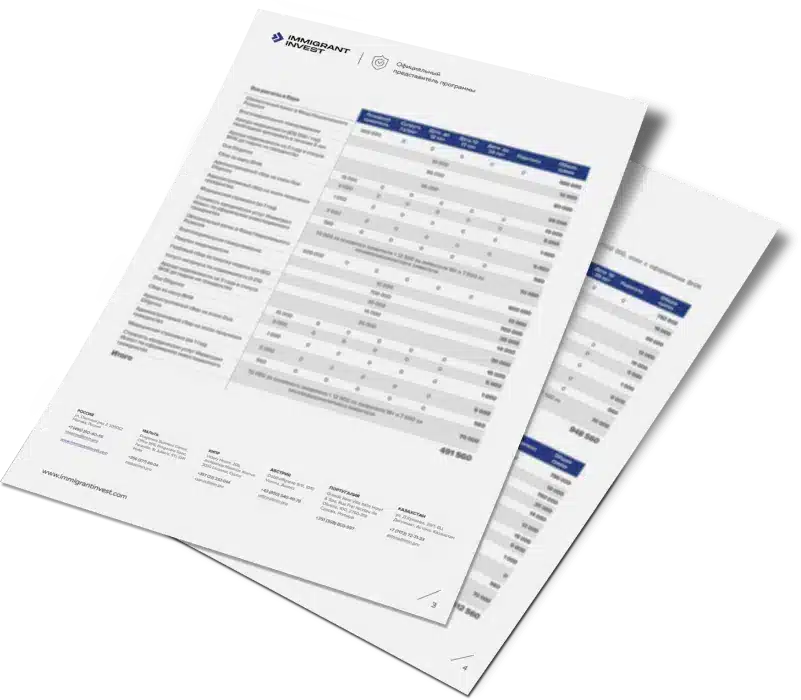
Besides the investment itself, applicants face some additional costs. A Caribbean citizenship by investment comparison should also take into account state and processing fees, investment-specific payments, and Due Diligence charges.
St Kitts and Nevis
State and processing fees associated with citizenship by investment in St Kitts and Nevis include:
- Application processing fee — $250 per person.
- Biometric fee — $2,500 for the investor; $2,000 per family member over 16; $1,300 per family member under 16.
- Passport fee — $361 per person.
- Certificate of naturalisation fee — $50 per person.
Due Diligence fee:
- $10,000 for the principal applicant;
- $7,500 for each dependent over 16.
Children under 16 are exempt from Due Diligence.
State fee for property investments. When choosing the real estate investment route, applicants face an additional fee:
- $25,000 for the investor;
- $15,000 — for a family member over 18;
- $10,000 — for a family member under 18.
State fee under the Public Benefit option. Applicants opting for the contribution to public good pay an additional fee as well. It varies depending on the exact investment project.
Antigua and Barbuda
State and processing fees under the Antigua and Barbuda citizenship by investment programme include:
- Processing fee of $20,000 for a family of up to four. Starting from the fifth dependent, the fee increases by $10,000 per person.
- Interview fee — $1,500 per person.
- Passport issuance fee — $300.
Due Diligence fee:
- $8,500 for the principal investor;
- $5,000 for the spouse;
- $4,000 for each family member over 18;
- $2,000 for each family member aged 12 to 17.
Grenada
State and processing fees of Grenada’s citizenship by investment programme include:
- Interview fee — $1,000 per applicant over 17.
- Application fee — $1,500 per person.
- Processing fee — $500—1,500 per person.
- Passport fee — $250—350 per person.
- Courier fee — $150 for a family.
Due Diligence fee of $5,000 is paid for each applicant over 17 years old.
State fee for investing in property. When investing in real estate, applicants pay an additional fee of $50,000 for a family of up to 4.
For larger families, the fee increases with each dependent starting from the fifth by:
- $25,000 — for each parent and grandparent over 55 and for each child;
- $50,000 — for a parent or grandparent under 55;
- $75,000 — for each sibling.
Real estate investors also pay a share registration fee of around $11,000.
St Lucia
The processing fee under St Lucia’s citizenship by investment programme is $2,000 for the investor and an additional $1,000 for each family member.
The Due Diligence fee is $7,500 for the investor and $5,000 per family member.
The state fee for real estate investment is:
- $30,000 — for the investor;
- $15,000 — for the spouse;
- $10,000 — for each family member over 18 other than the spouse;
- $5,000 — for each family member under 18.
The state fee for bond investment is $50,000 for the whole family regardless of its composition.
The state fee for business investment depends on the type of project an applicant opts for and starts from $15,000 for the main applicant.
Dominica
The state and processing fees for Dominica citizenship by investment applicants include:
- Processing fee — $1,000 for the family.
- Interview fee — $1,000 for the family.
- Issuance of the Certificate of Naturalisation — $500 per applicant,
- Issuance of the passport — $250 per applicant.
- Courier fee — $500 for the family
Due Diligence fee in Dominica is $7,500 for the investor and $4,000 for each family member over 16. Younger children are exempt from this fee.
The state fee for real estate investment varies depending on family composition:
- $75,000 — for a single investor;
- $100,000 — for a family of up to four;
- $40,000 — for each additional family member over 18 starting from the fifth;
- $25,000 — for each additional family member under 18 starting from the fifth.
Total cost for obtaining Caribbean citizenship through fund investment
| Country | Single investor | Family of four, children of 12 and 17 |
| St Kitts and Nevis | $263,161 | $285,444 |
| Antigua and Barbuda | $260,300 | $274,700 |
| Grenada | $244,500 | $263,250 |
| St Lucia | $249,500 | $267,500 |
| Dominica | $210,000 | $271,000 |
Application process for obtaining a Caribbean passport
The minimum timeframe for obtaining a Caribbean passport by investment varies by country — from at least 4 months in St Kitts and Nevis to 8 months in Grenada.
The preliminary stage before applying for citizenship includes selecting a licensed agent and preparing the required documents. It usually takes two to four weeks. After that, the licensed agent sends the documents for processing to the CBI Unit.
A designated Compliance Department at Immigrant Invest checks the investor’s background against international legal and business databases. It helps to see whether there is any risk of citizenship application denial.
This check takes one business day and requires only a client’s passport.
If the client successfully passes the preliminary check, Immigrant Invest offers to conclude an agreement to assist in obtaining citizenship.
We will offer a solution if any “red flags” have been discovered. For example, to consider another programme or prepare additional documents clarifying the situation.
The investor provides lawyers with the required personal and financial records. Namely:
- valid international passport;
- no criminal records certificate;
- birth certificate;
- certificate confirming the applicant’s marital status, e.g. a marriage or divorce certificate;
- bank statements confirming sufficient funds for investing and the legitimacy of income sources;
- health insurance policy.
This list may be incomplete as lawyers provide an individual one to each client depending on the chosen programme, investment option and the number of participating family members.
For the lawyers’ part, they organise the translation and notarisation of all documents, fill in the citizenship application form and prepare the investor’s CV.
Lawyers submit the application and scans of documents to the chosen programme’s website and send the originals to the CBI Unit for consideration and Due Diligence.
After applying, documents are processed within three months on average. It is the time required to complete the Due Diligence check.
After completing Due Diligence, the CBI unit notifies the investor about the decision. If the application was approved, the investor can proceed to fulfilling the chosen investment condition.
Applicants for St Kitts and Nevis citizenship are also required to travel to the nearest authorised centre to submit biometrics before their new passports can be issued.
Within two weeks, the applicant and their family members receive Certificates of Naturalisation and their Caribbean passports by a courier.
Comparison of time frames: how fast can an investor get a second passport?
When the application is approved in principle, the investor transfers money to a state fund or a developer’s escrow account. Investors usually have 60 or 90 days to fulfil the investment conditions.
The passport and naturalisation certificate are usually issued and delivered within two weeks after investing.
Obtaining citizenship in a Caribbean country takes at least:
- 4 months in St Kitts and Nevis;
- 6 months in Antigua and Barbuda, Dominica, and St Lucia;
- 8 months in Grenada.
Which country to choose for second citizenship by investment?
Caribbean CBI programmes offer broadly similar core benefits: lifetime citizenship, the right to include family members, no need to relocate, and access to many visa-free or simplified-entry destinations.
The best Caribbean passport is not the same for every investor. The right choice depends on the applicant’s budget, family composition, preferred investment route, travel needs, and long-term plans.
Dominica may suit investors who want the most cost-efficient real estate route. It is the only Caribbean CBI country where approved real estate investment still starts at $200,000, and the property can generally be resold after 3 years. If the buyer is another CBI applicant, the required holding period is 5 years.
This makes Dominica attractive for investors who want a tangible asset and a shorter route to capital return compared with most other Caribbean real estate options.
Antigua and Barbuda is often a practical choice for larger families. Its University of the West Indies Fund option is available for families of six or more and entitles one family member to a one-year tuition-only scholarship at the University of the West Indies.
St Lucia is suitable for investors who want flexibility. The programme offers several routes, including a fund contribution, approved real estate, government bonds, enterprise projects, and infrastructure-related options.
The option to invest in the National Action Government Bonds is especially useful for investors who prefer a capital-return route without buying property: the bonds are non-interest-bearing and must be held for 5 years.
St Lucia also does not oblige applicants to visit the country or travel to any specific place to submit biometrics. The citizenship acquisition process can be done fully remotely.
Grenada is the strongest option for investors who have business plans in the United States. Grenadian citizens are eligible for the US E-2 Treaty Investor visa, which allows nationals of treaty countries to invest in and direct a business in the US.
The route is not automatic: applicants who obtained Grenada citizenship by investment must consider the 3-year domicile requirement introduced for E-visa applicants who acquired treaty-country nationality through financial investment.
St Kitts and Nevis may appeal to investors who prioritise premium real estate and a long-established citizenship route. It has operated the world’s oldest citizenship by investment programme and offers several routes, including the Sustainable Island State Contribution, approved real estate, private real estate and the Public Benefit Option.
For travel planning, investors should also compare the destinations they personally need. All five Caribbean CBI countries currently allow short visa-free stays in the Schengen Area.
The UK access differs: citizens of Antigua and Barbuda, Grenada, and St Kitts and Nevis can visit the UK with an eTA, while citizens of Dominica and St Lucia need one.
For China, Grenada and Dominica remain the most relevant options among the five Caribbean CBI countries, as their citizens can visit China visa-free for up to 30 days.
Frequently asked questions
Which Caribbean countries offer citizenship by investment?
There are five countries in the Caribbean granting citizenship by investment. Those are Antigua and Barbuda, Dominica, Grenada, St Kitts and Nevis, and St Lucia.
The minimum investment sum is $200,000 to 250,000, depending on the country. This sum implies a non-refundable contribution to a state fund for a single applicant.
How much does a Caribbean passport cost?
It depends on the chosen programme, investment option and the number of family members in your citizenship application.
$200,000 is the minimum investment amount for a fund contribution in Dominica, the same option requires at least $250,000 in St Kitts and Nevis.
Investing in Caribbean real estate financial threshold varies from $200,000 in Dominica to $325,000 in St Kitts and Nevis.
Applicants also pay for Due Diligence, application processing, passport issuance, and naturalisation certificates.
Which is the best Caribbean citizenship by investment programme?
It depends on your tasks and goals.
Dominica offers the lowest investment threshold for both fund contribution and the real estate investment option. Besides, it allows for the fastest return of capital — property investors can resell it in 3+ years.
St Kitts and Nevis boasts the highest-ranked Caribbean passport, as recognised by Professional Wealth Management magazine.
St Lucia offers the most diverse list of investment options, including business contributions and acquisition of government bonds.
Antigua and Barbuda has an attractive investment option for large families of six people and more.
Grenada will suit those who are looking to build stronger connections with the US through investment.
Which Caribbean country is easiest to get citizenship?
There is no single “easiest” Caribbean citizenship by investment programme: all five countries require document preparation, source-of-funds checks, Due Diligence, and approval by the government authority. The right option usually depends on the investor’s profile, family composition, budget, and preferred investment route.
Dominica is often considered one of the most straightforward and cost-efficient options, especially for single applicants and real estate investors.
Antigua and Barbuda may be convenient for larger families, especially because it offers several routes, including the National Development Fund, real estate, business investment, and the University of the West Indies Fund.
What is the cheapest Caribbean island to get citizenship?
The Caribbean nation with the most cost-effective citizenship-by-investment programme is Dominica with its financial threshold of $200,000.
However, the lowest threshold does not automatically mean the best Caribbean citizenship by investment programme for every applicant. Investors should also compare Due Diligence requirements, family eligibility, processing timelines, government fees, travel opportunities, real estate resale rules, and long-term plans.
Understanding the difference between dual citizenship and obtaining a second citizenship is essential. In the Caribbean, individuals can acquire second citizenship without the need to renounce their original passport.
Conversely, dual citizenship is contingent upon the specific agreements between the investor’s home country and the Caribbean nation offering the second citizenship. The feasibility of dual citizenship largely depends on whether the investor’s country of origin has established reciprocal agreements with Caribbean countries regarding citizenship status.
Which is the strongest Caribbean passport?
The “strongest” Caribbean passport depends on the investor’s priorities rather than a single ranking. For some applicants, strength means easier travel to Europe or the UK; for others, it means access to China, eligibility for the US E-2 Treaty Investor visa, family inclusion, or long-term stability of the programme.
Grenada may be stronger for investors with US business plans, as its citizens can apply for the E-2 Treaty Investor visa. Dominica and Grenada suit better for frequent travellers to China, while Antigua and Barbuda, Grenada, and St Kitts and Nevis are currently more convenient for UK travel than Dominica and St Lucia.
How long does it take to obtain Caribbean citizenship by investment?
Caribbean citizenship by investment takes at least 4 months. The exact timeline depends on the country, the investor’s documents, Due Diligence checks, family composition, and the selected investment route.
Can I include my family members in a Caribbean citizenship application?
Yes. All five Caribbean CBI programmes allow investors to include eligible family members, such as a spouse, children, and in many cases parents or grandparents. Some countries also allow siblings. The exact rules differ by programme.
Do Caribbean citizenship programmes require residence or visits to the country?
Caribbean CBI programmes do not require investors to relocate before or after obtaining citizenship.
There are some country-specific formalities. Antigua and Barbuda requires successful applicants to spend at least 5 days in the country within the first 5 years after obtaining citizenship.
St Kitts and Nevis introduced biometric enrolment in 2026, which can be completed in the country, at consular offices, or through approved service providers worldwide.
Are there any tax benefits for Caribbean citizens?
Caribbean CBI countries generally offer favourable tax environments, but citizenship alone does not automatically change an investor’s tax obligations. In most cases, tax residence matters more than citizenship.
For example, Dominica lists the absence of capital gains tax, wealth tax, and inheritance tax among the benefits of its citizenship programme.
Can I hold multiple Caribbean citizenships at the same time?
The five Caribbean CBI countries allow multiple citizenship, so obtaining one Caribbean passport does not automatically prevent an investor from applying for another.
Learn more about Caribbean citizenship programmes
Sources:
- Source: Citizenship by investment unit of Antigua and Barbuda, Legislation
- Source: Citizenship by investment unit of St Kitts and Nevis, Understanding the new Biometrics Programme
- Source: Citizenship by investment unit of Dominica, Dominica CBI in-country visit requirement
- Source: CARICOM, Member States and Associate Members
- Source: CARICOM, The Right of Establishment
 Zlata Erlach