

Offices worldwide
April 23, 2026
Reading time: 24 min

15 best Golden Visa programmes: investment options in the Caribbean, Oceania, Europe, and Asia

For those seeking global mobility, financial security, or a second home, Golden Visa and citizenship by investment programmes open doors to new opportunities.

Whether it’s a powerful second passport from the Caribbean or residency in Europe, business expansion in the UAE, the investment routes provide a fast track to long-term benefits such as visa-free travel, tax advantages, and access to stable economies.

Explore the world’s top investment programmes, their requirements, and benefits.

Lyle Julien
Lyle Julien
Listed the best investment programmes
Fact checked by Elena RudaElena Ruda
Elena Ruda
Fact checked by Elena Ruda
Elena helped over 500 investors’ families to choose and obtain second citizenship or residency. She knows the pros and cons of each investment option and improves the industry expertise at the company.
Reviewed by Vladlena BaranovaVladlena Baranova
Vladlena Baranova
Reviewed by Vladlena Baranova
Vladlena leads preparation to Due Diligence and application for citizenship or residency by investment. She performs independent and in-depth analysis of investors’ situations and indicates possible risks. Vladlena helped to get second passports and residence permits to over 300 investors from all over the world.
Best Golden Visa programs

What is a Golden Visa?

Golden Visas have become one of the most popular routes for investors and families looking to secure residence rights abroad. In addition to residence status, they provide greater travel freedom, access to new markets, and in some cases a path to citizenship.

In a general sense

A Golden Visa is a residency by investment program, RBI, that allows foreign investors to obtain a residence permit in a country by making a qualifying investment. These programmes are attractive to individuals seeking greater mobility, access to better business opportunities, or a potential pathway to citizenship.

Most Golden Visa programmes require an investment in real estate, government bonds, or investment funds. 

Golden Visas are widely available in Europe, where they provide access to the Schengen Area, allowing visa-free travel across multiple countries. Programmes in Portugal[1], Greece, Italy, and the UAE are among the most popular. Additionally, permanent residency programmes in Cyprus and Malta offer similar benefits but grant long-term residence immediately with minimal stay requirements.

In a broader sense

Citizenship by investment, or CBI programmes are sometimes also referred to as Golden Visas. They provide a direct route to second citizenship and are an excellent alternative for those seeking a passport rather than just residency.

The “Caribbean Five” — St Kitts and Nevis, Antigua and Barbuda, Dominica, Grenada, and St Lucia — consistently rank among the top CBI programmes. Their strong CBI Index ratings highlight a well‑balanced mix of global mobility, efficient processing, and strict Due Diligence.

For those seeking an even faster route to citizenship, Vanuatu, in Oceania, offers the quickest processing time. In the CBI Index 2024, Vanuatu ranks 8th.

Residency or citizenship by investment: what to choose?

Choosing between residency by investment and citizenship by investment depends on your priorities: establishing a flexible base in another country or obtaining full legal membership in one. Below, we look at how the two routes differ in legal status, geography, investment structure, timelines, stay requirements, and risk profile.

Legal status. Residency‑by‑investment grants residence status, allowing investors to live, study, and work in the country, access regional markets, and enjoy limited travel benefits, such as visa‑free movement within the Schengen Area.

Citizenship-by-investment grants full citizenship status, including a second passport, unrestricted right to live and work in the country, broader visa-free travel, and the same political and legal rights as native-born citizens.

Region. In practice, the world is already divided between the two models:

  1. Residency by investment programmes dominate in Europe. Investors usually start with a residence permit that can later lead to permanent residence and then citizenship.
  2. Direct citizenship by investment is far more common in other regions, especially the Caribbean, where several countries offer a straight route to a second passport.

Investment size and structure. There is no strict rule that residency is cheap and citizenship is expensive. Each country sets its own thresholds and structures.

Some citizenship options in the Caribbean start at levels comparable to mid range residence routes, while certain European or Asian residency programmes require multimillion investments into funds or businesses. The real difference is not the price tag, but the type of contribution:

  • property, funds or business capital for many residence permits;
  • state funds, bonds, property or development projects for most citizenship programmes.

Investors should compare total cost, holding period and exit options.

Processing time varies by route and region. Fastest routes to citizenship today are Vanuatu and São Tomé and Príncipe, where an investor can obtain citizenship in about 2 months once all documents and payments are in place.

Caribbean citizenship by investment takes around 6‑8 months from application to approval, assuming smooth Due Diligence.

European Golden Visas vary by country and workload, but in practice investors should expect roughly 4 months to one year from filing to residence card.

Minimum stay requirements:

  1. RB typically has: very light or even nil stay requirements, especially when the focus is on investment and not on integration.
  2. CBI usually has no stay requirement at all for the main applicant. You are not expected to move there before or after naturalisation, although spending time in the country is always possible.

Risk and Due Diligence. Whatever route you choose, the screening standards are high. Applicants for both residency and citizenship by investment go through multi layer Due Diligence that typically includes background checks, source of funds analysis and international sanctions screening. 

Comparison of Golden Visa requirements

CountryMinimum investmentStatusObtainment period
Caribbean
Dominica$200,000Citizenship6+ months
Antigua and Barbuda$230,000Citizenship6+ months
Grenada$235,000Citizenship8+ months
St Lucia$240,000Citizenship6+ months
St Kitts and Nevis$250,000Citizenship6+ months
Oceania
Vanuatu$130,000Citizenship2—4 months
Africa
São Tomé and Príncipe $90,000Citizenship2+ monts
Europe
Portugal€250,000Temporary residency12+ months
Greece€250,000Permanent residency4+ months
Hungary€250,000Temporary residency5+ months
Italy€250,000Temporary residency4+ months
Andorra€600,000Temporary residency2+ months
Malta€169,000Permanent residency6+ months
Cyprus€300,000Permanent residency9+ months
Asia
UAEAED 750,000, ≈ $204,000Residency2+ months
SingaporeSGD 10 million, ≈ $7.78 millionPermanent residency6+ months

Which Caribbean countries offer the best Golden Visas?

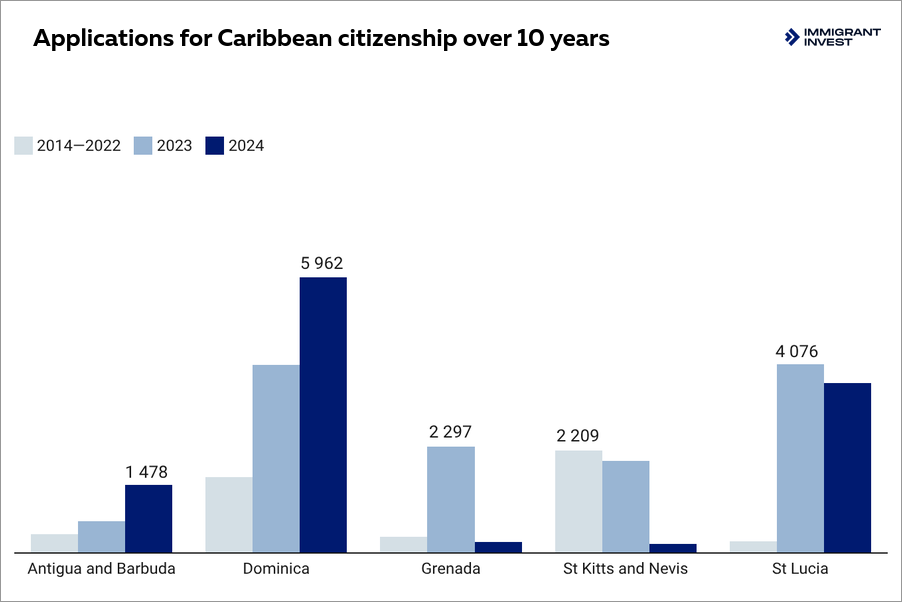
Since 2014, Caribbean citizenship has been granted to over 100,000 investors and their family members. Dominica leads with almost 50,000 passports issued. St Kitts and Nevis follows, granting over 35,000 passports. Antigua and Barbuda has issued over 8,500 passports, and Grenada — over 6,000.

St Lucia received more than 7,000 applications between 2015 and 2024, though the total number of issued passports remains undisclosed[2].
The popularity of Caribbean Golden Visa programmes changes over time. In the first half of 2024, Dominica continued to lead with the highest number of applications received, while St Lucia ranked second.

Statistics on Caribbean citizenships by investment applications

All Caribbean CBI  programmes provide at least two pathways to citizenship. Each country offers the option of a non-refundable contribution to a government fund. These funds support key sectors such as education, healthcare, green energy, agriculture, and tourism.

The second common option is investment in government‑approved real estate, including luxury hotels, villas, apartments, resort complexes, and infrastructure projects such as marinas. Investors can rent out their properties, generating annual yields of 2‑5%, and later resell them after a specified period.

1. Dominica

Dominica offers the lowest investment threshold among Caribbean CBI programmes, requiring a minimum investment of $200,000 in either a government fund or real estate.

Properties can be resold after three years to a buyer outside the programme or after five years to another investor seeking citizenship.

Family members, including a spouse, children under 30, and parents and grandparents over 65, can also obtain a Dominica Golden Visa.

2. Grenada

Grenada also provides two pathways to citizenship — through a fund contribution or a real estate purchase.

The fund contribution requires a minimum of $235,000.

For the real estate option, the minimum investment is $350,000, which can be reduced to $270,000 if:

  • the investor buys a share in a government‑approved tourism real estate project;
  • at least two people participate;
  • the combined investment totals at least $440,000.

Properties can be sold after five years, allowing the applicant to recoup their investment.

Family members can also obtain a Grenada Golden Visa. These include a spouse, children under 30, parents, grandparents, and siblings.

3. Antigua and Barbuda

Antigua and Barbuda offers four investment options, with the fund contribution requiring a minimum investment of $230,000. Real estate purchases must be worth at least $300,000, with properties eligible for resale after five years.

Investors can also choose the business investment route:

  • sole investment of $1.5 million in an Antigua and Barbuda business;
  • group investment of $5 million, with each participant contributing at least $400,000.

Family members can also obtain an Antigua and Barbuda Golden Visa. These include a spouse, children under 30, parents, grandparents, and siblings.

A unique option for large families of six or more members allows them to contribute $260,000 to an educational fund, with processing fees included.

4. St Lucia

St Lucia allows foreign investors to obtain passports through four pathways, with a fund contribution requiring $240,000.

Two additional investment options start at $300,000, including:

  • purchase of government bonds, which may be redeemed after five years;
  • purchase of real estate, which may be resold after five years, with values rising by 3—5% annually.

Alternatively, foreigners can invest $250,000 in a government-approved business project, such as restaurants, cruise ports, marinas, bridges, roads, pharmaceuticals, or research facilities. Other projects require a minimum investment of $3.5 million, while a group investment of $6 million allows each participant to contribute at least $1 million.

Family members, including spouses, children under 30, parents, and siblings, are also eligible for a St Lucia Golden Visa.

5. St Kitts and Nevis

St Kitts and Nevis offers three pathways to citizenship. The fund contribution requires a minimum of $250,000.

The public benefit option is another route, also requiring $250,000. Investments are directed toward social and infrastructure-related real estate projects, which may be either public or private.

The real estate option requires:

  • $325,000 for shares in tourism‑related real estate and condominiums;
  • $600,000 for private detached houses.

After seven years, the property can be sold for a profit.

Spouses, children under 25, and parents of the investor can also obtain St Kitts and Nevis citizenship.

Investment real estate in St Kitts and Nevis

Fraction in five star hotel under management of Hyatt Group
St Kitts & Nevis, Basseterre
$350,000+
Fraction in five star hotel under management of Hyatt Group
Share in a villa and apartments in a luxury hotel complex
St Kitts & Nevis, Frigate Bay
$325,000+
Share in a villa and apartments in a luxury hotel complex
58 m²
1—3
1—4
St Kitts & Nevis, Basseterre
$2,575,000+
Villa with pool in a landscaped park
379 m²
4
4

What are the benefits of Caribbean Golden Visas?

Remote application and no presence requirement. A key advantage is the remote application process, allowing investors to obtain citizenship without physical presence, language exams, or history tests.

Regional integration and Commonwealth benefits. All five countries are CARICOM members, ensuring freedom of movement, economic cooperation, and trade benefits within the region. As Commonwealth members, citizens enjoy easier UK access, eligibility for scholarships, and diplomatic protections abroad.

Global mobility and key visa waivers. Caribbean CBI passports offer visa-free or visa‑on‑arrival access to many countries, including Singapore and the Schengen Area. Grenada and Dominica stand out with visa-free entry to China. 

Grenada citizens can apply for US E-2 Investor Visa, enabling relocation, business ownership, and residence in the US without a minimum net worth or job offer. 

Tax advantages. Caribbean nations have favourable tax policies, with no wealth, inheritance, or capital gains taxes. Antigua & Barbuda and St Kitts and Nevis impose no personal income tax, while the other three only tax locally earned income.

What is the best Golden Visa in Oceania?

🇻🇺 Vanuatu offers the fastest citizenship-by-investment program, with passports issued in just 2—4 months. Applicants are not required to pass language proficiency or history exams.

The Vanuatu Golden Visa stands out for its low minimum investment threshold, starting at $130,000 as a non-refundable contribution to a state fund. Alternatively, investors can put $157,000 into the CNO Future Fund, supporting coconut oil production as a renewable energy source, with a return of at least $50,000 over five years.

Family members, including a spouse, children under 25, and parents over 50, can join the main applicant and obtain Vanuatu citizenship.

Investors can also benefit from establishing an international business company in Vanuatu. While these companies cannot generate local income, they enjoy significant tax incentives. Both the company and its shareholders are exempt from taxes on corporate profits, personal income, capital gains, inheritance, and donations. 

How Caribbean and Vanuatu CBI options differ by risk and return?

Antigua and Barbuda, St Kitts and Nevis, Dominica, Grenada and Saint Lucia all publish their investment options and key conditions through dedicated citizenship by investment units, which set out the minimum amounts, Due Diligence process and holding periods for each route. 

Non-refundable contributions

Non refundable contributions to state funds such as the Economic Diversification Fund in Dominica, the National Transformation Fund in Grenada or the National Economic Fund in Saint Lucia offer maximum simplicity and high capital security, since there is no exposure to market prices, although there is also no capital recovery. 

Real estate purchase

Approved resort real estate projects in Antigua and Barbuda, St Kitts and Nevis, Dominica, and Grenada add the possibility of rental income and future resale, but liquidity and returns depend on tourism demand and the specific project, and investors must usually hold the asset for at least five years. 

Vanuatu sits alongside these Caribbean programmes as another fast-track route to citizenship. Instead of a simple non-refundable contribution, investors now focus on sustainability themed projects such as the CNO Future Fund, acquiring shares in a Vanuatu international company that finances coconut oil and cocoa production as clean, renewable energy and export crops. 

Comparison of returnable options

InvestmentExitPotential returnRisksGovernment feeDue Diligence
Antigua and Barbuda real estate — $300,000+Resale allowed after 5 yearsAround 2—5% yearly rent plus possible appreciationTourism cycle, hurricane exposure, project delivery risk$10,000 single; $20,000 family up to 4$8,500 main applicant; $5,000 spouse; $4,000 dependant 18+; $2,000 dependant 12—17 
St Kitts and Nevis real estate — $325,000+Resale allowed after 7 yearsAround 2—5% yearly rent plus possible appreciationTourism cycle, hurricane exposure, project delivery and resale risk$25,000 main; $15,000 spouse; $10,000 dependant under 18; $15,000 dependant 18+$10,000 main;$7,500 dependant 16+
Dominica real estate — $200,000+Resale allowed after 3 years, or 5 years if resold to another CBI applicantAround 2—7% yearly rent plus possible appreciationTourism cycle, hurricane exposure, approved-project and resale-to-CBI rules$75,000 main; $100,000 up to 5 dependants; $25,000 extra dependant under 18;$40,000 extra dependant 18+$7,500 main;$4,000 each dependant 16+ 
Grenada real estate — $270,000+Resale allowed after 5 yearsAround 2—5% yearly rent plus possible appreciationTourism cycle, hurricane exposure, approved-project and resale risk$50,000 for a family up to 4;$25,000+ starting with the 5th applicant$5,000 per applicant aged 17+
St Lucia real estate — $300,000+Resale allowed after 5 yearsAround 2—5% yearly rent plus possible appreciationTourism cycle, hurricane exposure, approved-project and resale riskGovernment fees apply and depend on family sizeDue Diligence applies and depends on applicant type and age
Vanuatu CNO Future Fund — $157,000+Exit usually after 5 yearsTarget up to 5% yearly, about $50,000 over 5 yearsProject execution, commodity price and liquidity riskUsually included in the option fees$9,000+

Which countries offer the best European Golden Visas?

Europe remains one of the most attractive regions for Golden Visa investors, offering residency in countries with strong economies, high living standards, and access to the Schengen Area. 

Among the most sought-after programmes are those in Portugal, Greece, Hungary, Italy, Malta, and Cyprus, each with distinct investment requirements, residency benefits, and potential pathways to citizenship.

1. Portugal

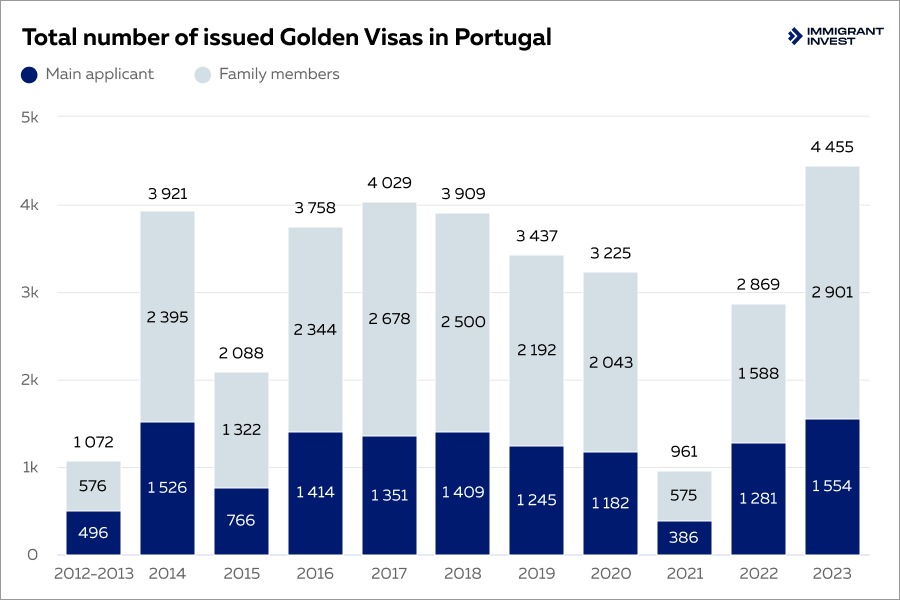
Portugal Golden Visa is one of the most popular residency programmes among investors, with around 33,000 residence permits issued since its inception in 2012.

The Portugal Golden Visa programme is attractive due to its minimal physical presence requirement. Investors need to spend just seven days per year to maintain their residency, which is also sufficient to qualify for citizenship. Portugal offers one of the fastest routes to European citizenship, allowing investors to obtain a passport after just five years of residency.

Applicants can choose from five investment options:

  • €250,000 for supporting arts and cultural heritage restoration;
  • €500,000 for purchasing investment fund units;
  • €500,000 for investments in research activities;
  • €500,000 for business investment, provided it creates at least five jobs;
  • unspecified amount for opening a company, requiring the creation of at least ten jobs.

The most popular option is investing in fund units, which must be held for at least five years. However, investors typically receive their funds back within six to ten years.

Family members, including a spouse, children under 26, and parents, are also eligible for residency.

The Portugal Golden Visa has issued a total of 33,724 residence permits since its inception in 2012. The programme is most popular among investors from China, followed by Brazil, the US, Turkey, and South Africa.

Portugal Golden Visa statistics

2. Greece

Greece Golden Visa programme has issued nearly 50,000 residence permits, including renewals, to investors since its launch in 2014. Unlike Portugal, it provides permanent residency and does not require residents to stay in the country, making it an even more attractive option for those seeking flexibility[3]. However, to qualify for citizenship in seven years, applicants must spend at least 183 days per year in Greece.

Greece offers nine investment options for obtaining a residence permit, with real estate purchase being the most popular. The minimum investment amount varies depending on the property’s location:

  • €800,000 in Attica and Thessaloniki, on Mykonos, Santorini, and islands with more than 3,100 residents;
  • €400,000 in all other regions.

The minimum investment requirement is lowered to €250,000 for properties intended for renovation or conversion into residential space.

The other eight options include:

  • 10-year lease of tourist accommodation — €400,000;
  • timeshare for tourist accommodation — €400,000;
  • receiving real estate as inheritance or a gift — €400,000;
  • purchase of shares in mutual or alternative investment funds — €350,000;
  • opening a fixed‑term deposit‑€500,000;
  • purchase of government bonds‑€500,000;
  • capital investments in Greek companies ‑€500,000;
  • purchase of corporate and government bonds listed for trading‑€800,000.

Spouses, children under 24, and parents can also qualify for the Greece Golden Visa with the main applicant.

Foreign investors who obtain Greek tax residency can benefit from a special tax regime. Instead of paying the standard income tax, with rates reaching up to 45%, they can opt for a flat tax of €100,000 per year on their global income. Additionally, close family members can join the regime, paying €20,000 annually each.

3. Hungary

Hungary Golden Visa, launched in 2024, has already attracted significant interest. By September 30, 2024, over 100 investors had applied for Hungarian residency, with 11 applicants successfully obtaining their residence permits.

The Hungary Golden Visa stands out for its 10-year validity, requiring no renewals during this period. Residency can be extended once for another 10 years[4]. After 11 years of continuous residence, investors become eligible for Hungarian citizenship.

Two options are available under the Hungary Golden Visa Program:

  • purchase of real estate fund units — €250,000;
  • donation to an institution of higher learning — €1,000,000.

Family members eligible for the visa include a spouse, children under 25, and parents.

Hungary offers some of the lowest tax rates in Europe, with a 15% income tax and a 9% corporate tax, the lowest in the EU.

4. Italy

Italy Golden Visa, like the Greece Golden Visa, appeals to investors seeking flexibility, as it does not require them to spend a minimum amount of time in the country to maintain residency[5]. However, to become eligible for Italian citizenship after 10 years, investors must reside in Italy for at least 183 days per year.

Italy offers four investment options:

  • investment in an innovative startup — €250,000;
  • business investment — €500,000;
  • donation to a philanthropic organisation — €1,000,000;
  • purchase of government bonds — €2,000,000.

Spouses, unmarried children of any age, and parents can also be included in the application for the Italy Golden Visa.

New residents in Italy can take advantage of a special tax regime, allowing them to pay a flat tax of €200,000 per year while being exempt from taxes on foreign income. Additionally, they are only required to pay gift and inheritance taxes on assets located in Italy. This tax regime is available for up to 15 years.

The Italy Golden Visa remains relatively unpopular, with just 63 applications submitted between 2018 and 2021. Most applicants came from Russia, the US, the UK, and Canada.

5. Andorra

Andorra Passive Residency programme is designed for individuals who wish to reside in the country without engaging in local employment or business. Their income must be sourced from abroad.

To qualify for the program, an investor must meet the following conditions:

  • invest at least €552,500 in Andorran assets, including real estate, financial products, or business ventures;
  • make a €47,500 interest-free and refundable deposit to the Andorran Financial Authority;
  • have an annual income of at least €52,100.

Spouses and children under 25 can be included in the Andorra Golden Visa application. In such cases, the applicant must demonstrate an additional income of €17,370 per family member, along with an extra €9,500 per dependent added to the required investment amount.

The Andorra residence permit is initially issued for two years with the possibility of extension. To maintain residency status, residents must spend a minimum of 90 days per year in Andorra.

Andorra residents do not pay wealth or inheritance taxes, while dividends, capital gains, and business profits are taxed at a flat 10% rate. Additionally, inheritance, wealth, and dividends from a holding company remain fully exempt from taxation.

Best Golden Visa programmes: Andorra
The average property price in Andorra is around €4,600 per m2. To qualify for the visa, purchasing a 120 m2 property would meet the investment requirement

6. Malta

Malta Permanent Residence Programme grants lifetime rights to live in the country[6]. It is particularly attractive to investors relocating with large families, as it allows them to include spouses, children under 29, parents, and grandparents.

To qualify, investors must meet several financial requirements, including real estate purchase or rental, administrative and state fees, and a mandatory donation to a Maltese organisation. While all conditions are compulsory, investors can choose between renting or purchasing property.

The minimum rental price is €14,000 per year, with a commitment to lease the property for five years.

If purchasing, the minimum property price is €375,000.

Additionally, investors must pay:

  • fixed administrative fee of €60,000;
  • donation of €2,000 to a Maltese NGO;
  • contribution fee of €37,000.

In total, the minimum cost for obtaining Malta permanent residence is €169,000 for renting and € 474,000 for purchasing real estate.

The Malta Permanent Residence Programme has approved 7,567 applications between its launch in 2015 and 2021. In 2024, the programme received 1,500 new applications, with the majority of investors coming from China, followed by Vietnam, Russia, South Africa, and Turkey.

7. Cyprus

Cyprus Permanent Residence also stands out for its lifelong validity. It offers investors a path to Cypriot citizenship after 8 years of continuous residence.

Investors can choose from several investment options, each requiring a minimum investment of €300,000. Eligible investments include residential or commercial real estate, shares in Cypriot companies, or units of local investment funds.

Spouses and children under 25 are also eligible for the Cyprus Permanent Residence Program.

For those purchasing residential property, VAT applies. The standard VAT rate is 19%, but it is reduced to 5% if the property serves as the investor’s primary residence and is not rented out.

Cyprus residents benefit from no tax on global income or inheritance, while the corporate tax rate of 12.5% is among the lowest in Europe.

How do European Golden Visas differ by risk, return and liquidity?

In Europe, Golden Visa and passive residence investments sit along a spectrum between capital security, rental income and long term growth. 

Fund units and bond purchase

At the most conservative end are government bonds and regulated investment funds, where the portfolio is diversified and returns are usually moderate but more predictable. Examples include investment funds under the Portugal Golden Visa, real estate funds in Hungary and government bonds in Italy, which prioritise capital protection and regulatory oversight over very high returns.

Real estate purchase

Real estate options in Greece, Malta, Cyprus and Andorra add the potential for rental income and capital appreciation but introduce market and location risk. Properties in capital cities and established tourist areas can deliver attractive yields, yet prices and occupancy levels are sensitive to local demand, tourism flows and changes in regulation such as limits on short term letting. 

Liquidity is also lower than for listed securities, since selling a qualifying property takes time and involves transaction costs.

What are the best Asian Golden Visas?

Golden Visa opportunities in Asia stand out for their scale and exclusivity. Programmes in Singapore and the UAE cater to investors seeking access to leading financial centres, long‑term residence rights, and favourable conditions for both families and businesses.

1. Singapore

Singapore Global Investor Program, GIP, is designed for high-net-worth individuals looking to obtain Singapore permanent residency[7]. The programme has a low physical presence requirement, requiring residents to spend only one day per year in Singapore.

To qualify for a Singapore Golden Visa, applicants must invest at least:

  • SGD 10 million, ≈ $7.5 million, in a new or expanding business in Singapore;
  • SGD 25 million, ≈ $19.4 million, into a GIP-select fund that invests in Singapore‑based companies;
  • SGD 200 million, ≈ $155.6 million, by establishing a single-family office that manages assets of this value.

Under the family office route, it is also required to deploy a minimum of SGD 50 million, ≈ $38.9 million, in one or more of the following asset categories:

  • equities, REITs, or business trusts listed on Singapore‑approved exchanges;
  • qualifying debt securities under the Monetary Authority of Singapore’s system;
  • funds managed by Singapore‑licensed financial institutions;
  • private equity investments in Singapore-based non-listed operating companies.

Family members, including a spouse and unmarried children under 21, are also eligible for a Singapore Golden Visa. Children above 21 can apply for a Long-Term Visit Pass, which is tied to the validity of the main applicant's re-entry permit.

The permanent residence permit is issued for five years, with the possibility of extension. However, after two years of continuous residency, investors become eligible for Singaporean citizenship. This requires renouncing their original nationality, as Singapore does not allow dual citizenship.

Best Golden Visa programmes: Singapore
Singapore Global Investor Programme attracted approximately $5.46 billion in investments and created over 24,000 jobs between 2011 and 2022

2. UAE

UAE Golden Visa allows investors, entrepreneurs, and highly skilled professionals to obtain 10-year or 2-year residence permits[8].

The 10-year visa requires purchasing property worth at least AED 2 million, ≈ $545,000. Part of the investment can be financed through a mortgage with a minimum 20% down payment.

The 2-year visa is available for a real estate purchase of AED 750,000, ≈ $204,000. If the property is jointly owned with a spouse, the minimum investment increases to AED 1 million, ≈ $272,000. Investors using a loan must pay at least 50% upfront.

The UAE Golden Visa is extended to a spouse, unmarried sons under 25, and unmarried daughters of any age.

The UAE Golden Visa does not require holders to live in the UAE full-time, allowing residents to spend unlimited time abroad without losing their visa status. Besides, the 10‑year visa can be renewed an unlimited amount of times.

The UAE does not tax personal income, inheritance, capital gains, gifts, or properties. Corporate tax is set at 9%, but only for companies with annual profits exceeding AED 375,000, ≈ $102,000.
Launched in 2019, the UAE Golden Visa has experienced rapid growth, surpassing the issuance numbers of many EU residency programmes.

Best Golden Visa programmes: UAE
In 2023, 158,000 UAE Golden Visas were granted, nearly doubling the 80,000 issued in 2022 and more than tripling the 47,000 approvals in 2021

How do Asian Golden Visa investments compare by risk, return and liquidity?

Golden Visa routes in Asia focus on large scale capital and long term residence in world class business hubs. 

In Singapore, the Global Investor programme offers permanent residence to investors who commit substantial capital to a business, a government-approved fund or a single‑family office that manages at least SGD 200 million in assets, with at least SGD 50 million deployed into qualifying local investments. 

These options emphasise active economic contribution and high potential for capital growth, but they are concentrated and designed for sophisticated investors who accept equity style risk and longer lock ups.

In the United Arab Emirates, Golden Visa property routes allow investors to obtain two‑year or ten-year residence permits by buying real estate in Dubai, Abu Dhabi or other emirates, starting at AED 750,000 for a shorter term visa and two million dirhams for a 10-year permit. 

Residential property in Dubai combines strong rental demand with relatively high gross yields, which in late 2024 averaged around 6 to 7% a year for apartments in key areas. 

At the same time, investors must be comfortable with exposure to a single market that is driven by global capital flows, tourism and local regulation.

Latest legislative changes and warnings

Golden Visa rules are not frozen. Thresholds are rising, Due Diligence is tightening and, in Europe in particular, some programmes have been reshaped or closed. The picture is different by region.

Caribbean, Oceania and Asia: changing investment threshold

In the Caribbean and Vanuatu the overall citizenship by investment model has remained intact. Investors still choose between a state fund contribution and approved real estate or hotel projects. What has changed is the financial requirements and the terms.

In 2024 and 2025, the five main Caribbean citizenship‑by‑investment countries signed a regional memorandum that increased the minimum investment threshold from $100,000 to at least $200,000 and aligned several rules on Due Diligence, marketing and information exchange.

There is ongoing discussion in the Eastern Caribbean about adding modest physical presence requirements, for example a short stay in the country within the first years after naturalisation, to demonstrate a real connection and meet EU concerns about visa free travel.

In Oceania, Vanuatu has already faced the harshest consequence of EU scrutiny: the loss of visa-free access to the Schengen Area. At the same time, the programme’s core investment options and overall citizenship model have changed much less than the EU’s reaction to them. 

In Asia, headline structures are stable, but thresholds have risen over time. In Singapore, the Global Investor Programme increased the entry point for the cheapest route from SGD 2.5 million, about $1.9 million, to SGD 10 million, about $7.5 million, for a business investment. 

The approved fund option now starts at SGD 25 million, about $19.4 million. The single family office route requires SGD 200 million, about $155.6 million, in assets under management, with at least SGD 50 million, about $38.9 million, deployed into approved local investments.

Europe: structural reforms and rising political scrutiny

Europe is where the most profound changes are happening. Residency by investment is now framed inside wider debates about housing affordability, inequality and migration management.

Citizenship by investment is being treated even more strictly. The EU is effectively terminating any programmes that resemble the purchase of citizenship and expects the same approach from candidate countries as part of alignment with EU standards. 

Several concrete legal shifts stand out: 

  1. Malta citizenship for exceptional services by direct investment is terminated. The Court found that this route amounts to commercialising Union citizenship and therefore breaches EU law.
  2. Greece has restructured its programme with a tiered map that raises minimum property investments to €800,000 in prime zones and €400,000 in other regions, and has started to tighten rules around short term rentals and property use.
  3. Hungary closed its Golden Visa in 2017 and relaunched it in 2024 under a completely new legal framework focused on guest investor status and real estate funds.
  4. The UK, Ireland and Spain have closed their investor residence programmes for an indefinite period, so new applicants can no longer obtain residence through investment in these countries.
  5. Portugal has abolished the real estate option and now directs capital into funds, research, culture and business rather than personal property.
  6. Cyprus no longer offers a direct citizenship by investment route for investors and has shifted back to more traditional residence based paths.

You can learn more about how residency and citizenship by investment are evolving, and how they fit into wider migration flows, in Immigrant Invest’s latest European migration trends report, which brings together official statistics, programme updates and expert analysis.

Requirements for Golden Visa applicants

Primary applicants must be at least 18 years old to qualify for a Golden Visa.

Programmes may restrict applications from specific nationalities due to diplomatic, political, or security reasons. Restrictions vary by country. For example, citizens of Cyprus, North Korea, Russia, and Belarus are not eligible for the Greece Golden Visa.

Financial stability

Authorities conduct Due Diligence checks to ensure that the investment capital comes from legal sources. Applicants must usually provide:

  • bank statements and financial records; 
  • proof of income or business ownership;
  • tax compliance documentation.

Some programmes also require proof of financial independence, ensuring that applicants have sufficient funds to support themselves and their families.

Clean criminal record

Most Golden Visa programmes require applicants to provide police clearance certificates from their country of residence and previous countries of residence. Applicants must not have a history of financial fraud, money laundering, or any other criminal offenses.

Minimum stay requirement

Some Golden Visa programmes require investors to spend a minimum number of days annually in the country to maintain residency. For instance, in Portugal, residents must be present for at least seven days per year.

Health insurance

Golden Visa countries require proof of comprehensive health insurance. Some programmes may also require medical examinations to confirm that applicants do not have dangerous infectious diseases.

Passing a Due Diligence check

This is a key part of the Golden Visa application process, ensuring that investors meet legal, financial, and security standards. Governments conduct thorough background screenings to prevent money laundering, fraud, and security risks.

Citizenship and Golden Visa programmes face criticism from the EU and civil society over Due Diligence concerns, with warnings that poor regulation could grant EU access to individuals with criminal ties or tax evasion records. In response, countries have tightened screening, with nations like Malta conducting multi‑layered checks on investors, their families, and financial networks.

At Immigrant Invest, we conduct preliminary Due Diligence before application submission, ensuring that our clients meet all compliance standards. Our process reduces rejection risks to less than 1%, giving investors confidence that their application will stand up to scrutiny.

Lyle Julien
Lyle Julien,
Investment programmes expert

Step-by-step procedure for obtaining a European Golden Visa

The process of obtaining a Golden Visa is largely similar across European countries, with minor variations. Based on the experience of Immigrant Invest, it takes at least four months to secure residency status.

[P12M]
1 day
Preliminary Due Diligence

An Immigrant Invest Compliance Officer checks the applicant’s background against international databases, reducing the risk of refusal to 1%.

This check is mandatory before signing a contract. If any risks are found, we suggest solutions such as submitting additional documents or choosing another program.

1—2 weeks
Preparing documents
Preparing documents

Lawyers complete government forms and compile a list of required financial and personal documents. The investor gathers the necessary paperwork and signs a power of attorney.

1—2 weeks
Obtaining a tax number

In countries like Portugal and Greece, investors must obtain a tax number, which is required for opening bank accounts, purchasing real estate, registering a business, and other legal transactions.

Up to 3 months
Fulfillment of investment condition

Depending on the chosen option, applicants purchase real estate, invest in fund units, start a business and create jobs, or make other contributions.

Lawyers collect and submit all necessary documents to confirm the investment and ensure compliance with the program’s requirements.

1 day
Applying for a residence permit

The application for a residence permit is submitted remotely through electronic government services.

Investors provide scanned copies of their personal and financial documents, investment proof, and any required forms.

1—2 weeks
Submission of biometrics

The investor and their family must travel to the country of future residence to submit original documents and fingerprints for the residence permit.

Up to 8 months
Receiving residency cards

The application processing time depends on the country, varying from 1‑2 months in Hungary or Greece to up to 8 months in Portugal.

The investor can collect the permit in person or authorise a lawyer to do so on their behalf. Upon collection, they must present their international passport and, if required, provide additional biometrics.

Government fees apply, covering processing and issuance of the permit.

How to renew a Golden Visa?

Golden Visa holders must renew their permit after an initial period of 2, 5, or 10 years, depending on the country.

To renew, applicants usually need to:

  • maintain the initial investment;
  • spend a minimum number of days in the country, if required;
  • prove financial self-sufficiency;
  • prove a clean criminal record and valid health insurance;
  • pay renewal fees.

Only Andorra and Portugal require applicants to spend time in the country to renew a residence permit. Portugal mandates a minimum stay of seven days per year, while Andorra requires at least 90 days annually.

Renewals are granted for another 2, 3, 5, or 10 years, depending on the country's immigration policy.

Golden Visa tax residency implications for US investors

For most investors, a second citizenship or residence permit can open the door to tax planning and, in some cases, lower effective taxation. For US citizens and green card holders, it is more complex. 

The United States taxes US persons on worldwide income, so they must report their income to the IRS regardless of where they live, work, or invest, including foreign property income, fund gains, and overseas bank accounts[9].

What tax residency means for US Golden Visa holders

Tax residency is a legal concept that is separate from immigration status. It determines which country has the right to tax a person’s worldwide income. In most countries, tax residency depends on physical presence, at least 183 days per year.

A Golden Visa usually does not require you to live in the country most of the year. This means, many American investors do not spend enough time there to become tax residents, so they do not pay local taxes on their worldwide income.

If a US investor moves to another country and spends enough time there to qualify as a tax resident, the situation changes. They must then follow that country’s tax rules, which typically means:

  • paying taxes in the new country of tax residence under local rules, potentially including worldwide income taxation;
  • filing US tax returns and reporting worldwide income to the IRS, even if taxes were already paid abroad.

Do US citizens with foreign tax residency pay tax twice on all income?

Tax residence in another country does not remove US filing and payment obligations. The IRS still expects annual reporting of worldwide income. Many investors also face extra reporting for foreign companies, funds, trusts, and overseas bank or investment accounts. 

For example, FBAR is required if the combined balance of foreign accounts exceeds $10,000 at any point during the year, while FATCA Form 8938 applies once foreign financial assets pass $50,000—100,000 for US residents or $200,000‑400,000 for those living abroad, depending on filing status.

You can avoid double taxation if the country has an income tax treaty with the United States and you claim relief correctly, most often via the Foreign Tax Credit. The US treaty network covers more than 60 countries.

In some destinations, the local tax bill can also be reduced through special regimes for new tax residents. For example, Greece offers an alternative regime where eligible new tax residents can pay a flat €100,000 per year on foreign income for up to 15 years.

Investment structures that need special attention

Many popular Golden Visa investments can create extra paperwork for US citizens, so it is worth checking the structure before you invest.

Investment income and the PFIC alert. Most non-US mutual funds and ETFs are treated as PFICs, passive foreign investment companies, for US tax purposes. This matters because PFICs often mean more filing and, if you do not make the right choice, a much harsher tax outcome.

If you own PFICs, you may need to file Form 8621 for each PFIC. A common de minimis rule can remove the filing duty when your total PFIC holdings are small, often cited as $25,000 for single filers and $50,000 for joint filers, but the rules have important exceptions.

Without a specific PFIC election, the default method can tax gains in a punitive way.

Rental income from foreign property. If you rent out overseas property, the IRS still expects you to report it, generally on Schedule E, Form 1040. The key difference from a US rental is depreciation. Foreign residential rental property is generally depreciated under ADS over 30 years for property placed in service after 2017, not 27.5 years. Depreciation is calculated on Form 4562.

The Foreign Earned Income Exclusion does not apply to rental income because it is not earned income. In practice, double taxation is usually handled through the Foreign Tax Credit if tax is paid abroad.

Foreign business ownership. If you own at least 10 percent of a foreign company, you may trigger controlled foreign corporation rules and additional reporting. Form 5471 is the core information return, and late or missing filing can trigger significant penalties.

Another issue is that you can be taxed on some profits even if you do not pay yourself dividends. From tax years starting in 2026, the US rules are also changing, with the GILTI regime being renamed and adjusted under the One Big Beautiful Bill Act and related provisions, which makes early structuring even more important for internationally mobile founders.

Form 8992 is used to calculate the inclusion under the current GILTI framework.

Foreign accounts and extra reporting. Foreign bank and investment accounts can trigger standalone reporting even when there is no tax due. Many investors need:

  • FBAR, FinCEN Form 114, once foreign account balances pass the threshold;
  • FATCA reporting, usually Form 8938, once the relevant asset thresholds are met.

Quick form cheat sheet for US investors:

  • Foreign mutual funds and ETFs, most non US funds — Form 8621;
  • Foreign rental property income — Schedule E, Form 1040;
  • Depreciation for foreign rental property — Form 4562;
  • Foreign company ownership, common for 10 percent plus holdings — Form 5471;
  • Calculating GILTI inclusions under current rules — Form 8992;
  • Foreign taxes paid to reduce double taxation — Form 1116;
  • Foreign earned income exclusion for qualifying salary and self employment income — Form 2555;
  • Foreign bank and investment accounts — FBAR, FinCEN Form 114;
  • FATCA foreign asset reporting — Form 8938 [10].

How to obtain permanent residency or citizenship after a Golden Visa

Golden Visas start as temporary residence permits but can open the door to permanent residency or citizenship. The path varies by country — in some, like Hungary and Portugal, it takes a few years, while in others, such as the UAE and Andorra, the process can stretch over decades.

Permanent residency

Typically, Golden Visa holders become eligible for permanent residency after five years, granting unlimited residency rights without the need for renewals. However, Hungary offers a faster route, allowing investors to apply for permanent residency after just three years.

Citizenship

Citizenship requirements vary by country, but all applicants must pass a language and culture exam and take an oath of allegiance, affirming their commitment to the country’s laws and values.

Singapore offers the fastest path to citizenship, requiring just two years of permanent residency. However, applicants must renounce all other nationalities, as dual citizenship is not permitted.

Among European countries, Portugal stands out with a five‑year residency requirement, the shortest in the EU. It also has the most lenient physical presence rule, requiring applicants to spend just seven days per year before becoming eligible for citizenship.

In contrast, Italy, Greece, Cyprus, and Hungary impose stricter residency conditions, requiring applicants to spend at least 183 days per year in the country. The waiting periods for citizenship vary:

  1. Greece grants citizenship after 7 years.
  2. Cyprus mandates 8 years of residency.
  3. Italy requires 10 years of residence.
  4. Hungary mandates 11 years from the date of the first residence permit.

The strictest paths are found in the UAE and Andorra. The UAE only grants citizenship in exceptional cases, such as to investors, scientists, or distinguished professionals, after 30 years of residency. Andorra, one of the most restrictive nations, requires 20 years of residence and renunciation of previous nationality. Additionally, applicants must pass a Catalan language and culture exam.

  1. The most popular European Golden Visas include Portugal and Greece. Minimum investment thresholds start at €250,000.
  2. Malta and Cyprus stand out with lifelong permanent residence programmes that eliminate the need for renewal. Minimum investments start at €169,000 in Malta and €300,000 in Cyprus.
  3. Caribbean CBI programmes are an attractive alternative for investors seeking second citizenship rather than residency. These programmes are available in Dominica, St Kitts and Nevis, Grenada, St Lucia, and Antigua & Barbuda.
  4. Dominica is the most popular among the Caribbean Five, also offering the lowest investment threshold of $200,000.
  5. In Oceania, Vanuatu boasts the fastest citizenship‑by‑investment program, granting a passport within 2‑4 months with a minimum investment of $130,000.

Frequently asked questions

What are the minimum stay requirements for the most popular Golden Visa programmes ?

Most leading Golden Visa programmes have very light or even nil stay rules for keeping residency, but stricter rules if you want citizenship. For example, Portugal requires 14 days in the country in each two-year residence period, which is enough both to maintain the permit and qualify for citizenship after five years. 

Greece and Malta have no minimum stay at all to keep residence, while Italy’s Investor Visa and the Cyprus permanent residence route also do not require you to live there to renew your status, although you must spend around 183 days per year if you later want citizenship. 

In the UAE there is no strict annual stay rule for the property-based Golden Visa, and Singapore’s Global Investor programme expects only a token presence, such as one day per year, to keep permanent residence.

Can citizenship be purchased directly through a Golden Visa program, or is residency required first?

Most modern Golden Visas are residency-by-investment, not direct “citizenship for sale”. In Europe, programmes in Portugal, Greece, Italy, Malta’s MPRP and Cyprus are all based on residence first, with citizenship only available after several years of living there and meeting language and integration tests where required. 

Direct citizenship by investment still exists mainly in the Caribbean and a few other countries, but the EU is closing or banning “golden passport” schemes, as seen with Malta citizenship for exceptional services by direct investment being ordered to shut down by the EU Court of Justice. 

In practice, an investor should assume residency first, then citizenship later if they genuinely relocate and meet the long-term rules.

How does the US EB-5 Investor Visa compare in cost and timeline to the European Golden Visas?

The US EB-5 visa is generally more expensive and slower than most European Golden Visas. Current EB-5 rules require a minimum investment of $800,000 in a Targeted Employment Area project or $1,050,000 for other projects, plus legal and filing costs that can bring the total above $1.1—1.2 million. 

Processing to get a conditional green card often takes around two to five years. 

By contrast, European Golden Visas usually start around €250,000—500,000 for real estate, funds or other qualifying investments, with residence cards typically issued in six to eighteen months and a path to citizenship after five to ten years, depending on the country and physical presence.

What are the long-term tax implications of obtaining residency through a Golden Visa for a US citizen?

For US citizens and green card holders, a Golden Visa does not switch off US tax. The United States taxes its people on worldwide income, so foreign property rents, fund gains and bank interest under a Golden Visa all remain reportable in the US, with possible foreign tax credits if you also pay tax in the host country. 

Many non-US funds and structures used in Golden Visa planning can be treated as PFICs or controlled foreign corporations, which often means higher tax and extra forms each year. 

Advogado Tributário Internacional

If you later become tax resident in the Golden Visa country, you may be fully taxable in two systems at once and will need careful planning around treaties, credits and local special regimes; fully leaving the US tax net is only possible by giving up citizenship or long-term resident status, which itself can trigger an “exit tax”.

Is dual citizenship allowed in all Golden Visa countries?

Yes. Many popular destinations such as Portugal, Greece, Italy, Cyprus and most Caribbean citizenship-by-investment states accept dual or multiple citizenships, so investors can usually keep their original passport. 

However, some countries either restrict dual citizenship or discourage it: Singapore generally does not allow adults to hold two passports, and several states require you to choose one nationality if you naturalise. 

The UAE has gradually relaxed its position for selected investors and professionals, but rules are still evolving and often applied case by case. 

For any specific program, it is essential to check both the host country’s rules and your home country’s stance on dual citizenship before applying.

Are there alternatives to Golden Visas?

Yes, a key alternative to the Golden Visa is the Digital Nomad or remote worker visa. It is based on income, not investment, and is usually temporary.

Examples of Digital Nomad Visas and income requirements:

  • Portugal — €3,680+ per month;
  • Greece — €3,500+ per month;
  • Spain — €2,600+ per month;
  • UAE — $3,500 per month.

Digital Nomad Visas are usually valid for 1—2 years, sometimes renewable, and rarely lead directly to permanent residence or citizenship, but they are cheaper and more flexible than Golden Visas for people who can work fully online.

What is the Golden Visa?

Golden Visa is a residency-by-investment programme that grants foreign investors and their families the right to live, work, and study in a country in exchange for a qualifying investment. These programmes typically offer renewable residence permits and, in some cases, a pathway to permanent residency or citizenship. The most popular European Golden Visas are in Portugal and Greece, with the UAE leading in Asia.

Which is the best Golden Visa program?

The best Golden Visa programme depends on an investor’s goals, whether it’s fast-track citizenship, real estate investment, or low physical presence requirements.

For a fast track to EU citizenship, Portugal stands out, allowing investors to apply after 5 years. Greece and Cyprus offer diverse real estate options and no minimum stay for residency renewal. Hungary’s Golden Visa grants a 10-year residence permit upfront, reducing bureaucratic renewals.

Which EU country has the best Golden Visa?

Portugal and Greece are among the most popular Golden Visa countries within the EU. Both programmes have a minimum investment threshold of €250,000. Portugal stands out for its fast-track citizenship in just 5 years, requiring only 7 days of physical presence per year. Meanwhile, Greece is known for its diverse real estate investment options and the absence of a minimum stay requirement to renew the residence permit.

Which country has the easiest Golden Visa?

The easiest Golden Visa depends on factors such as investment threshold, processing time, physical presence requirements, and path to citizenship.

Portugal is often considered the easiest due to its low physical presence requirement — just 7 days per year — and a fast track to citizenship in 5 years, one of the shortest in Europe. Greece and Hungary also stand out, as they do not require any minimum stay to maintain residency. Hungary offers a 10-year residence permit upfront, while Greece provides the most flexible real estate options starting at €250,000.

For those looking for the fastest processing time, the UAE’s Golden Visa is one of the quickest, often issued within 1—2 months.

What is the cheapest Golden Visa?

The most affordable Golden Visa programmes start at €250,000, with options available in Portugal, Greece, Hungary, and Italy. Malta offers an alternative with permanent residency, requiring a minimum investment of €169,000.

For those looking outside Europe, the UAE’s two-year Golden Visa is available with an investment of approximately $204,000.

Vanuatu is an appealing alternative to Golden Visas, offering citizenship instead of residency for an investment of just $130,000. It also stands out as one of the fastest citizenship by investment programmes, granting passports in as little as 2 to 4 months.

What is the disadvantage of the Golden Visa?

A Golden Visa provides residency but does not grant full rights like voting or holding public office. Unlike citizenship, it does not offer visa-free travel to all destinations, limiting mobility compared to a second passport. The path to citizenship is often long, requiring several years of residency and strict eligibility conditions. Investors may also face tax obligations, even if they spend little time in the country.

Citizenship by investment programmes in the Caribbean and Vanuatu offer a compelling alternative for those seeking greater flexibility and immediate global mobility. Unlike Golden Visas, CBI programmes grant citizenship directly, providing investors with second passports that allow visa-free travel to hundreds of destinations.

How much is the Golden Visa in Portugal?

Portugal’s Golden Visa requires investment of €250,000 for supporting arts and cultural heritage restoration, whereas the most popular option is purchasing investment fund units for at least €500,000.

Does the Netherlands have a Golden Visa?

Yes, the Netherlands offers a residency-by-investment program, often referred to as a Golden Visa, requiring a minimum investment of €1.25 million in a Dutch business or investment fund.

Citizenship by investment programmes in the Caribbean countries and Vanuatu are attractive alternatives to Golden Visas. These programmes grant second passports with valuable benefits such as visa-free travel, tax advantages, and financial security.

Is the UAE Golden Visa worth it?

Yes, the UAE offers one of the most sought-after Golden Visas, with 158,000 visas granted in 2023. An investment of at least $204,000 grants a 2-year residency, while a larger investment of $545,000 secures a 10-year residency, which can be renewed indefinitely.

Can a Golden Visa be used as a backup plan without immediate relocation?

Yes. Many Golden Visa programmes are suitable for investors who want a legal right to live in another country without moving there immediately. Stay requirements depend on the country: some programmes require only short visits, while others have no minimum stay requirement for maintaining residency.

Sources:

  1. Source: ARI online application portal, AIMA Portugal
  2. Source: Caribbean CBI applications, European Commission
  3. Source: Eligible investment routes, Greek Ministry of Migration and Asylum
  4. Source: Guest Investor Visa and Permit, FAQ, Hungary Government
  5. Source: Investor Visa options, Italian Government Investor Visa portal
  6. Source: MPRP requirements, Residency Malta Agency
  7. Source: GIP threshold updates, Singapore Economic Development Board
  8. Source: Real estate investor residence service, UAE ICP Federal Authority
  9. Source: US citizens worldwide income, IRS Publication 54

Source: Reporting foreign income, IRS Publication

15 best Golden Visa programmes: investment options in the Caribbean, Oceania, Europe, and Asia
Share:
Home Blog
15 best Golden Visa programmes: investment options in the Caribbean, Oceania, Europe, and Asia
Scroll to Top