

Offices worldwide
May 24, 2026
Reading time: 20 min

30 best countries for property investment: updated list in 2026

Real estate is one of the most reliable ways to invest your money. It not only helps you build long‑term value, but can also improve your lifestyle.

In 2025, buying property in certain countries can give you residency or citizenship, making it easier to move abroad or travel freely.

In this article, we compare 30 countries in terms of the profitability of real estate purchase and highlight the 10 best destinations for investors.

Vladlena Baranova
Vladlena Baranova
Helped define the best countries for property investment
Fact checked by Elena RudaElena Ruda
Elena Ruda
Fact checked by Elena Ruda
Elena helped over 500 investors’ families to choose and obtain second citizenship or residency. She knows the pros and cons of each investment option and improves the industry expertise at the company.
Reviewed by Vladlena BaranovaVladlena Baranova
Vladlena Baranova
Reviewed by Vladlena Baranova
Vladlena leads preparation to Due Diligence and application for citizenship or residency by investment. She performs independent and in-depth analysis of investors’ situations and indicates possible risks. Vladlena helped to get second passports and residence permits to over 300 investors from all over the world.
best countries for real estate investment

30 best countries to invest in real estate

We have shortlisted 30 countries that meet at least one of the following criteria:

Some of these countries offer residency or citizenship to those who purchase real estate above a specific threshold, typically through government-approved programs.

The table below provides a quick overview of the key metrics: average price per square metre, gross rental yield, estimated return on investment, and the minimum real estate investment required for migration purposes, where applicable.

Key real estate metrics by country

CountryAverage price, m²Average rental yieldResidency or citizenship by property purchaseMinimum investment
Antigua and Barbuda$11,0004.5%Citizenship$300,000
Austria$5,5003.0%NoN/A
Belgium$3,7003.2%NoN/A
Bosnia and Herzegovina$1,8005.5%NoN/A
Brazil$1,8006.0%Residency$150,000
Bulgaria$2,5005.0%NoN/A
Cyprus$3,5004.0%Residency$327,000
Dominica$2004.5%Citizenship$200,000
Egypt$1,0006.5%NoN/A
Georgia$1,2007.0%NoN/A
Germany$5,0003.5%NoN/A
Greece$3,0004.0%Residency$272,500
Grenada$1,5004.5%Citizenship$270,000
Hungary$3,0005.0%NoN/A
Indonesia$1,1006.0%Residency$150,000
Malta$3,5004.0%Residency$239,800
Montenegro$2,5005.0%Residency$272,500
Netherlands$4,8003.0%NoN/A
New Zealand$4,0003.5%No$2,960,000
Portugal$3,5004.0%NoN/A
South Africa$1,2007.0%Residency$200,000
Spain$3,0004.0%NoN/A
St Kitts and Nevis$4,5004.5%Citizenship$325,000
St Lucia$2004.5%Citizenship$300,000
Switzerland$14,0002.5%NoN/A
Thailand$3,0005.5%NoN/A
Türkiye$2,0006.0%Citizenship$400,000
UAE$4,5005.0%Residency$204,000
UK$4,5003.5%NoN/A
Uruguay$2,0005.0%NoN/A

9 key reasons to buy real estate abroad

1. Stable rental income

Well-located properties in high-demand markets can generate regular rental income. Some investors use this to cover living costs abroad or to reinvest in additional assets.

For instance, a flat in central Tbilisi, Georgia, may yield up to 8% annually, especially if rented short-term to tourists or digital nomads. In Antalya, Türkiye, seafront apartments can generate rental yields of 7% or more, driven by year-round tourism and growing expat demand.

2. Potential for long-term capital growth

Across the EU, residential property values increased by an average of 5.7% year-on-year in early 2025. The strongest growth was recorded in Portugal, Bulgaria, and Croatia.

Real estate prices tend to rise steadily in emerging markets and tourist destinations, particularly in areas with growing demand and limited housing supply.

Greece’s residential property market grew steadily in early 2025, with apartment prices rising by 6.8% year-on-year. Thessaloniki saw the highest increase at 10.0%, followed by other areas at 8.0%, other cities excluding Athens and Thessaloniki at 7.3%, and Athens at 5.5%.

3. Protection from inflation and currency risks 

Unlike fiat currencies or volatile digital assets, property often retains or increases its value over time. It can serve as a natural hedge against inflation and exchange rate volatility.

For example, investors who purchased property in Türkiye with US dollars in 2019, especially in high-demand areas like Istanbul and Antalya, saw prices rise by around 80% in dollar terms by the end of 2024. This nominal growth not only outpaced the depreciation of the Turkish lira and local inflation but also delivered a solid real return, even after accounting for global inflation.

4. Diversification of investment portfolio

Buying property abroad reduces reliance on domestic assets and helps protect against local economic or policy risks.

For example, a European investor exposed to EU real estate and taxes might buy a seafront villa in Antigua and Barbuda, benefiting from no taxes on foreign income, capital gains, inheritance, or wealth, while diversifying geographically.

Similarly, a South African investor might buy rental apartments in Greece or Cyprus for more stable euro-denominated assets.

5. Personal lifestyle benefits

For many investors, buying real estate abroad is not only a financial decision but also a lifestyle upgrade. Luxury properties in desirable locations offer comfort and prestige. They also provide direct access to better living conditions, whether that means a cleaner environment, milder climate, or safer urban infrastructure.

Cyprus is one of the most attractive destinations in the luxury segment. In 2025, Nicosia overtook Limassol as the country’s top luxury real estate market. The 10 most expensive transactions in Nicosia in March 2025 reached a total of €56.5 million.

6. A legacy for future generations

Real estate is one of the most tangible and transferable assets you can pass on to your children or other family members.

Some countries allow dependents to inherit residency or citizenship rights. Under the Grenada citizenship program, children born after naturalisation can inherit citizenship rights, as long as one parent is a citizen.

7. Tax planning and optimisation

In certain countries, foreign property owners benefit from low or zero property tax, no capital gains tax, or no inheritance tax. These jurisdictions may also offer favourable treatment for rental income earned abroad.

In the UAE, there is no annual property tax, and rental income is not taxed at the federal level.

Dominica generally does not impose an annual property tax. There is no capital gains tax on the sale of real estate. However, a municipal tax of 1.25% applies in specific areas such as Roseau and Canefield.

8. Full ownership and control of your asset

Unlike stocks or funds, real estate gives investors full ownership of a tangible asset, one that can be used, improved, or passed on. This level of control appeals to those who value autonomy and long-term security.

In countries like Greece, Türkiye, and the United Arab Emirates, buyers can own property outright and decide how it is used, whether for personal holidays, long-term rental income, or future resale.

9. Path to residence or citizenship

In some countries, investing in real estate can open the door to residence permits or citizenship. This allows investors and their families to live, study, work, or travel more freely, often within the Schengen Area or Commonwealth countries.

In Greece, a property purchase costing €250,000 can qualify the buyer for a residence permit. In Dominica, citizenship is available through approved real estate investments starting at $200,000.

Owning a property abroad can serve as a “Plan B,” offering a safe haven during political instability, economic crises, or personal emergencies. It gives you the flexibility to relocate quickly if needed. Many investors from high-risk countries choose second homes in Europe or the Caribbean to ensure safe relocation options for their families.

Vladlena Baranova
Vladlena Baranova,
Lawyer, AML Compliance officer, certified CAMS specialist

10 best countries for real estate investment and second residency

Some of the most attractive real estate markets in 2025 are those that combine profit potential with residence or citizenship benefits. These countries offer investors not only the chance to earn rental income or capital gains but also legal pathways to relocate, expand global mobility, or plan for future generations.

Below, we profile 10 best destinations to buy real estate. For each, we cover property prices, rental yields, investment thresholds, top regions, and the type of residency or citizenship available through real estate.

Best countries to buy investment property

Antigua and Barbuda

Property prices

Antigua and Barbuda offers a competitively priced property market compared to other island nations in the Caribbean. The average residential property price is around $3,800 per square metre.

Rental yields 

Rental yields are typically around 4.5% annually but can reach 8%. The demand is fuelled by the country’s growing tourism sector and limited coastal inventory.

Property tax

Antigua and Barbuda imposes an annual property tax based on the assessed market value of the property. Rates range from 0.10% to 0.50%, depending on the property’s classification and use.

Best regions for real estate investment

English Harbour, Jolly Harbour, and coastal resort zones are hotspots for strong rental demand and scenic properties.

Government-approved properties eligible for citizenship by investment

Apartments in a hotel complex by the sea
Antigua & Barbuda, Saint Philip
$350,000 — $750,000
Apartments in a hotel complex by the sea
1—2
1—2
Share, apartements, townhouse or villa in a resort on the coast of the island
Antigua & Barbuda, Saint Philip
$300,000 — $2,850,000
Share, apartements, townhouse or villa in a resort on the coast of the island
56 m² — 619 m²
1—5
1—5
Share in an oceanfront hotel complex
Antigua & Barbuda, Saint Philip
$300,000+
Share in an oceanfront hotel complex

Citizenship by Investment program

Through the Antigua and Barbuda Citizenship by Investment Program, investors can obtain citizenship by purchasing approved real estate, with a minimum investment of $300,000 for a single applicant or $200,000 per investor in a joint purchase.

This pathway requires not only acquiring government-approved property but also covering several mandatory fees, including Due Diligence checks, government processing charges, and legal services. For a single applicant, the key costs are as follows:

  • real estate investment — $300,000;
  • government processing fees — $10,000;
  • Due Diligence fees — $8,500;
  • passport fee — $300;
  • legal and administrative fees — typically 1% to 1.5% of the property value.

For applications that include a spouse or dependants, the government and Due Diligence fees increase.

Investors must hold the property for a minimum of 5 years, after which it can be sold or replaced with another qualifying asset.

Benefits

Key benefits of combining real estate with citizenship include:

  1. The program allows the inclusion of a spouse, children under 30, dependent parents, and unmarried siblings in a single application.
  2. Citizens of Antigua and Barbuda enjoy visa-free access to over 150 countries, including the Schengen Area, the United Kingdom, Singapore, and Hong Kong.
  3. Passport holders can apply for a B-1/B-2 visa, granting entry to the United States for up to 10 years.
  4. The country imposes no personal income tax, wealth tax, inheritance tax, or capital gains tax on non-residents.

Cyprus

Property prices

Cyprus offers a relatively accessible property market by EU standards. Average residential prices start at around €2,500 per square metre.

Properties in cities like Nicosia and Larnaca generally cost less than those in coastal regions such as Limassol or Paphos, where demand is higher due to strong international interest and limited housing supply.

Rental yields 

Rental yields in Cyprus begin at approximately 4%, varying by location and property type. Properties in popular tourist areas perform well during peak seasons, while apartments in cities sustain steady long-term rental demand, especially near business centres and universities.

Best regions for real estate investment

Limassol and Paphos are the most sought-after cities for investment, offering high rental demand and luxury coastal developments. Nicosia presents lower entry prices and a growing commercial market. Larnaca is viewed as an emerging market with strong yield potential.

Property taxes

Cyprus levies a tax of 3 to 8%, depending on the property’s value. First-time homebuyers using real estate as a primary residence benefit from a reduced 5% VAT rate instead of a standard rate of 19%.

Permanent residence by investment 

Cyprus offers investors the opportunity to obtain lifelong residence status by purchasing new residential or commercial real estate. The minimum investment is €300,000 in a government-approved property.

Investing in real estate to obtain residency in Cyprus involves more than just purchasing eligible property. Applicants must also meet certain income requirements and cover various administrative and legal expenses. Key costs include:

  • real estate investment — €300,000;
  • VAT — 5% or 19% of the property price, depending on the type and use of the property;
  • submission fee — €500;
  • registration fee — €70;
  • issuance of a residence permit card — €70;
  • legal fees — 1% of the property value;
  • medical insurance — €170 to 380;

Fees increase for applications that include a spouse or dependants.

The investor is required to confirm a minimum annual income of €50,000, plus an additional €15,000 for a spouse and €10,000 for each dependent child.

Investors must retain ownership of the property for as long as they wish to maintain permanent residency. However, the property can be sold without affecting residency status if citizenship is later obtained through naturalisation.

Benefits

Key benefits of combining real estate with residency include:

  1. Cyprus permanent residency extends to the spouse, minor children, and financially dependent adult children up to 25 years old.
  2. Residency is granted for life and does not require permanent physical relocation; only one visit to Cyprus every two years is necessary.
  3. After eight years of legal residency, investors become eligible to apply for Cypriot citizenship.
  4. Residency grants access to EU education, healthcare, and business opportunities.
  5. Cyprus imposes no tax on foreign income or inheritance, and its corporate income tax rate is one of the lowest in the EU at 12.5%.
Best European countries for real estate investment 2025
New homes in Cyprus increasingly feature eco-friendly designs like solar panels and energy-efficient systems, driven by EU standards and buyer demand

Dominica

Property prices

Dominica ranks among the most affordable real estate markets in the Caribbean, with average property prices around $2,000 per square metre. It is considerably lower than in more tourist-heavy Caribbean countries.

Rental yields 

Rental yields typically average about 4.5%, supported by Dominica’s strong reputation for eco-tourism and growing demand for low-density, sustainable developments. Although it is not a mass-tourism destination, the island’s natural beauty and appeal to adventure travellers help maintain consistent demand for short- and mid-term rentals.

Property taxes

Most real estate in Dominica is exempt from annual property tax. However, owners must pay a municipal tax, usually between 1.25 and 1.5% of the property’s assessed rental value.

Best regions for real estate investment

Portsmouth and the Cabrits National Park area are home to most government-approved resort developments. Roseau offers residential properties with steady rental demand. Eco-luxury lodges, such as those near Secret Bay, are especially popular among investors seeking high-end, low-density assets.

Government-approved properties eligible for citizenship by investment

Share and full ownership in a five-star resort managed by Autograph Collections (premium branded by Marriott)
Dominica, Portsmouth
$220,000 — $320,000
Share and full ownership in a five-star resort managed by Autograph Collections (premium branded by Marriott)
1—2
Share in a five-star hotel managed by Intercontinental
Dominica, Portsmouth
$220,000+
Share in a five-star hotel managed by Intercontinental
Dominica Citizenship
Dominica, Roseau
$216,000 — $3,800,000
Share and villas in a six-star resort
1—2
1

Citizenship by Investment program

Foreigners can obtain citizenship by purchasing government-approved real estate, with a minimum investment of $200,000.

Covering government and administrative fees is also required. For a single applicant, key costs include:

  • real estate investment — $200,000 in government-approved property;
  • government processing fees — $25,000;
  • Due Diligence fees — $8,500;
  • passport fee — $361;
  • application fee — $1,000;
  • legal and administrative fees — typically 1% to 2.5% of the property value.

For applications that include a spouse or dependants, the government and Due Diligence fees increase accordingly.

Benefits

Key benefits of combining real estate with citizenship include:

  1. Dominica Citizenship by Investment program allows the inclusion of a spouse, children under 30, dependent parents, and grandparents in a single application.
  2. Citizens enjoy visa-free or visa-on-arrival access to many countries, including the Schengen Area, the United Kingdom, China, and Singapore.
  3. Passport holders are exempt from taxes on global income, capital gains, wealth, and inheritance.
  4. Citizenship can be obtained remotely, without visiting Dominica, with an average processing time of around six months.

Greece

Property prices

Greece remains one of the most attractive real estate markets in the European Union, offering a strong balance of affordability and rental income potential. The average price per square metre is around €2,000, with lower prices found in inland or less tourist-heavy regions.

Prices in central Athens, Thessaloniki, and popular islands like Mykonos or Santorini can exceed €4,000 to 6,000 per square metre for prime properties.

Rental yields 

Rental yields typically range from 4% to 6% in cities like Athens and Thessaloniki, reaching as high as 8 to 10% in sought-after tourist destinations with seasonal demand.

Taxation

Property taxes in Greece are relatively low by EU standards. The primary real estate tax is the Uniform Real Estate Property Tax, ENFIA. It consists of two parts:

  1. Main tax, calculated per square metre based on property characteristics. Rates range from €2 to 13 per square metre.
  2. Supplementary tax, applicable to individuals whose total real estate value exceeds €400,000. The rate is 0.1 to 1.15%, depending on the total value.

There is no inheritance tax between first-degree relatives, and the 15% capital gains tax on real estate sales is currently suspended, making Greece fiscally attractive for long‑term property ownership and family asset planning.

Best regions for real estate investment

Athens and its southern suburbs, including Glyfada and Vouliagmeni, offer high rental demand and strong liquidity. Thessaloniki presents lower entry costs with growing appeal. Popular islands such as Mykonos, Santorini, and Crete attract lifestyle investors and short-term rental operators, although these often require higher minimum investments.

Residency by investment

The Greece Golden Visa allows foreigners to get a five-year renewable residence permit by investing in real estate. The minimum required investment depends on the property's type and location:

  • €250,000 — for properties needing renovation or conversion;
  • €400,000 — for standard homes in less competitive areas;
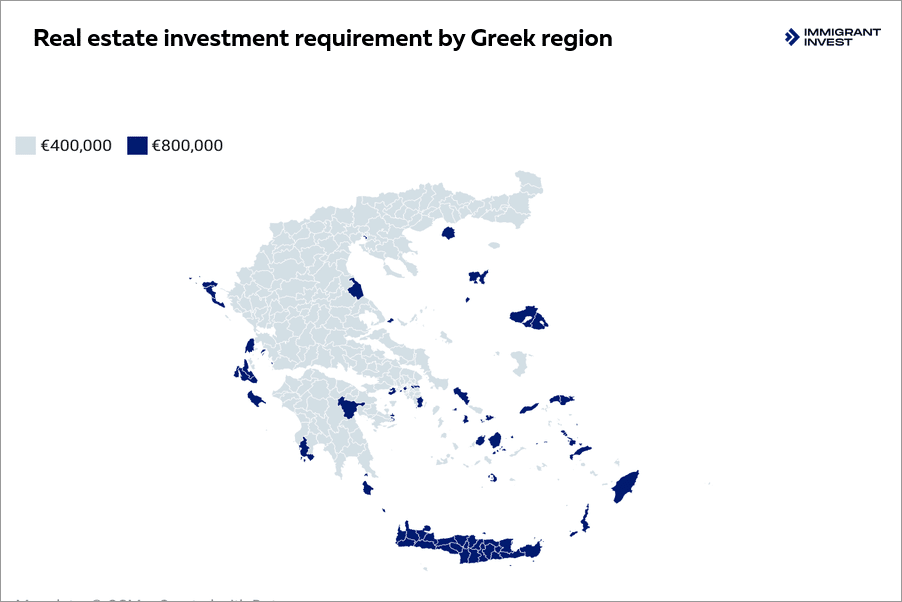
  • €800,000 — for new properties in high-demand zones like central Athens, Thessaloniki, Mykonos, and Santorini.

Other main costs include:

  • application fee — €2,000 for the main applicant and €150 per additional adult family member;
  • taxes and legal fees — approximately 5.5% of the property value;
  • medical insurance — around €300 per person annually;
  • passport-style residence card issuance fee — €16 per card.

The investor must keep the property to maintain residency. If it is sold, the permit is cancelled unless another qualifying property is bought.

Benefits

Key benefits of combining real estate with residency include:

  1. Greece Golden Visa covers the investor, their spouse or registered partner, children under 21, and both sets of parents.
  2. The residence permit is valid for 5 years and may be renewed indefinitely if the investment is maintained.
  3. Residents can travel visa-free within the Schengen Area for up to 90 days in any 180‑day period.
  4. After 7 years of legal residency, the investor may apply for Greek citizenship by naturalisation, subject to integration and language requirements.
  5. The Golden Visa allows property rental and does not impose minimum stay requirements. Rental income and gains may be tax-optimised through double taxation treaties.
Greece Golden Visa new rules
In most of Greece, the minimum investment threshold for buying property is €400,000, or $800,000. Although it can be as low as $250,000 for properties under reconstruction in any region

Grenada

Property prices

Grenada’s property market is considered relatively affordable by Caribbean standards, with average residential prices around $3,500 per square metre.

Rental yield

Properties near tourist hotspots or St George’s University typically generate gross yields of 4.5 to 5% per year, depending on location and season.

Property taxes

Grenada levies an annual property tax based on the assessed market value of the land and any buildings. Rates vary according to property use and classification, with commercial land taxed highest at 0.5%.

Best regions for real estate investment 

St George’s and Grand Anse host the majority of approved resort and residential developments. Lance Aux Épines is known for high-end villas and strong rental demand. Carriacou Island presents opportunities in boutique and eco-friendly tourism projects.

Government-approved properties eligible for citizenship by investment

Grenada citizenship by real estate investment: secure a second passport and rental yields
Grenada, St. George's
$270,000 — $350,000
Share or apartments in full ownership in an oceanfront university complex
1
1
Grenada, St. George's
$350,000 — $455,000
Share and apartments in a full ownership in a residential complex near the university
37 m² — 86 m²
1—2
1
Grenada passport renewal: guide for investors
Grenada, Saint Davids
$270,000+
Share in a new resort complex managed by the Intercontinental group

Citizenship by Investment program

Investors can obtain citizenship by purchasing government-approved real estate. The minimum investment is $270,000 for a share in property, or $350,000 for full ownership.

Investing in real estate for citizenship in Grenada involves purchasing approved property and covering several fixed government and administrative fees. For a single applicant, the key costs include:

  • real estate investment — $270,000+;
  • administrative fee — $50,000
  • government processing fee — $1,500;
  • Due Diligence fees — $6,000;
  • passport fee — $350;
  • application fee — $1,000;
  • other fees — approximately 1% to 2.5% of the property value.

For applications that include a spouse or dependants, the government and Due Diligence fees increase accordingly.

The investor must retain ownership of the property for at least 5 years. After this period, the property may be resold to any buyer, including other citizenship program participants.

Benefits

Key benefits of combining real estate with citizenship include:

  1. Grenada citizenship by investment allows the inclusion of a spouse, children under 30, dependent parents, grandparents, and unmarried siblings.
  2. Citizens of Grenada enjoy visa-free or visa-on-arrival access to many countries, including the Schengen Area, the United Kingdom, Singapore, Hong Kong, and China.
  3. Passport holders may apply for a US B-1/B-2 tourist visa valid for up to 10 years and qualify for the US E-2 investor visa.
  4. The country imposes no tax on worldwide income, capital gains, wealth, or inheritance.
  5. Citizenship applications can be submitted and approved remotely within 6 months.

Malta

Property prices

Average residential property prices are around €3,500 per square metre. Prices are highest in coastal areas such as Sliema, St Julian’s and Valletta, while more affordable options, often under €2,200 per square metre, are available in Gozo and southern Malta.

Rental yields

Rental yields typically range from 4 to 5%, especially for short‑term rentals in tourist‑heavy districts. Demand is supported by expats, international students and digital nomads, along with Malta’s stable economy and limited land availability.

Best regions for purchase

Many investors choose Gozo and southern Malta for rental or holiday properties. These areas offer lower entry prices and good potential for long-term appreciation as tourism and infrastructure continue to develop.

Property taxes

There is no annual property tax for real estate owners in Malta.

Residency by investment

Malta provides two real estate-related options for foreign investors. These routes cater to different goals, including permanent residency and special tax residency.

Malta Permanent Residence Programme, MPRP. Investors obtain permanent residency by purchasing or renting property in Malta. The minimum purchase value is €375,000 or €14,000 per year for rentals.

The property must be held or rented for at least 5 years.

Malta Global Residence Programme, MGRP, offers a tax residency status to non-EU investors who purchase or lease real estate and meet minimum tax requirements. 

Investors benefit from a special tax regime: 15% on foreign income remitted to Malta, 0% on income not transferred, and 35% on income earned in Malta, with a minimum annual tax of €15,000 per family. There are no extra taxes for family members or on inheritance.

There is no fixed holding period, but having a residency status depends on maintaining a qualifying property.

Investment requirements for the MPRP and MGRP

Cost itemMPRPMGRP
Property rent per year€14,000+€8,750+ — in Gozo or the south of Malta;
€9,600+ — in other regions
Property purchase€375,000+€220,000+ — in Gozo or the south of Malta;
€275,000+ — in other regions
Administrative fee€60,000+€5,500+
Contribution fee€37,000+
Charitable donation€2,000
Annual income tax€15,000+
Available financial assets€500,000+

Benefits

Key benefits of combining real estate with residency include:

  1. Both the MPRP and MGRP allow the inclusion of family members in one application, covering spouses and dependents.
  2. Residents of Malta can travel visa-free within the Schengen Area for up to 90 days in any 180-day period.
  3. Investors and their families gain access to Malta’s healthcare, banking, education, and legal systems.
  4. Real estate may appreciate in value in high-demand areas such as Sliema or St Julian’s.
  5. There is no minimum stay requirement to maintain residency under either programme.
  6. MGRP grants special tax status, allowing the investor to pay only 15% tax on foreign income that is remitted to Malta, with a minimum annual tax of €15,000.
Best countries for real estate investment
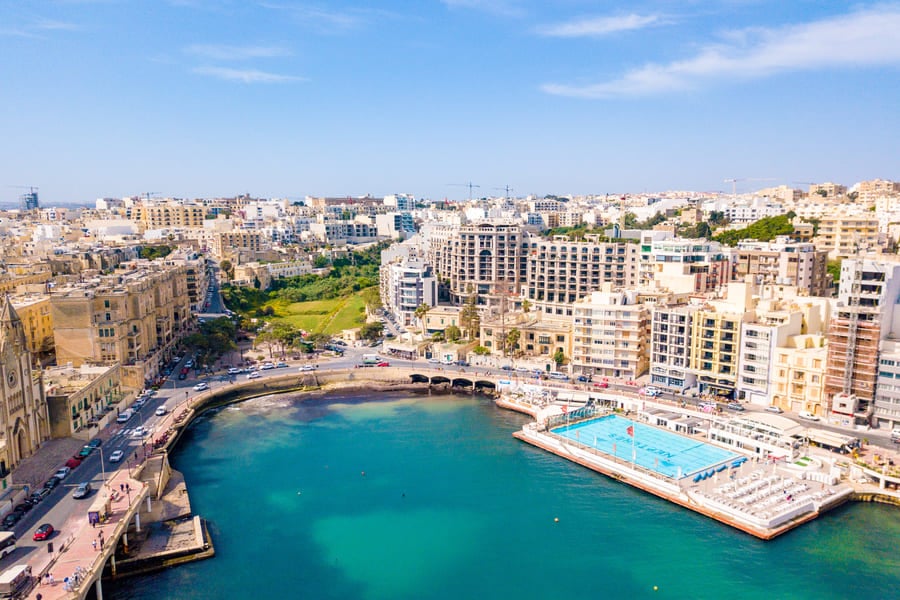
Maltese homes are built from limestone with thick walls and flat roofs, offering natural insulation and blending tradition with modern design

St Kitts and Nevis

Property prices

The average residential price is around $4,000 per square metre, with beachfront villas and branded residences in high-demand areas commanding higher rates.

Rental yields 

Rental yields typically range from 3 to 5% per year, supported by steady tourism and a limited supply of luxury coastal properties. Winter seasons offer the highest rental income.

Taxation

Property tax applies to both land and buildings. Rates vary based on property type and location, with tourist accommodations and commercial properties taxed at the highest levels. Residential land and buildings are generally taxed at rates between 0.156 and 0.75%.

Best regions for real estate investment

On St Kitts, Frigate Bay and the South East Peninsula are home to popular luxury developments, including hotel-branded residences and resort communities. 

On Nevis, areas like Charlestown and Newcastle offer high-end villa projects and boutique hospitality resorts that appeal to lifestyle investors.

Government-approved properties eligible for citizenship by investment

Share in a villa and apartments in a luxury hotel complex
St Kitts & Nevis, Frigate Bay
$325,000 — $4,000,000
Share in a villa and apartments in a luxury hotel complex
58 m² — 426 m²
1—3
1—4
Fraction in five star hotel under management of Hyatt Group
St Kitts & Nevis, Basseterre
$325,000+
Fraction in five star hotel under management of Hyatt Group
Share or apartment in a residential complex
St Kitts & Nevis, Nevis
$425,000 — $450,000
Share or apartment in a residential complex
70 m² — 116 m²
1—2
1—2

Citizenship by Investment program

Investors can obtain citizenship in St Kitts and Nevis by purchasing government‑approved real estate. The threshold is $325,000 for a share in a resort or condominium, or $400,000 to $600,000 for full ownership of a private property.

Investing in real estate for citizenship involves both the property purchase and several government and administrative costs. Key expenses include:

  • real estate investment — $325,000+;
  • state fee — $35,000;
  • processing fee — $250
  • Due Diligence fees — $10,000;
  • post-approval application fee — $25,000;
  • passport fee — included in administrative costs;
  • legal and administrative fees — typically 1 to 2% of the property value.

For applications that include a spouse or other dependents, the government and Due Diligence fees increase accordingly.

The property must be held for at least 7 years. After this period, it may be sold, including to another citizenship applicant.

Benefits

Key benefits of combining real estate with citizenship include:

  1. St Kitts and Nevis citizenship by investment allows the inclusion of a spouse, children under 25, dependent parents aged 65 and older, and unmarried siblings under 25.
  2. Citizens enjoy visa-free or visa-on-arrival access to many countries, including the Schengen Area, the United Kingdom, and Hong Kong.
  3. Income earned abroad, as well as capital gains and inheritance, are not taxed.
  4. The citizenship application can be completed remotely, and processing typically takes at least 6 months.
  5. After the required holding period, the investment property can be sold without affecting citizenship status.

St Lucia

Property prices

The average residential price is about $3,800 per square metre. Premium areas such as Rodney Bay and Gros Islet command higher prices due to their popularity and tourist infrastructure. Inland and less developed coastal towns offer more affordable options.

Rental yields

Rental yields average 4—5% annually, particularly for properties designed for short-term stays in resort zones or eco-tourism destinations. The country’s appeal to both tourists and remote workers has supported a stable rental market.

Property taxes

In St Lucia, annual property taxes are based on the market value of the property. Rates are 0.25 % for residential real estate and 0.4 % for commercial real estate.

Best regions for real estate investment

Rodney Bay and Gros Islet offer high rental potential and established infrastructure. Soufrière attracts lifestyle investors seeking eco-resorts and ocean views. Castries and nearby areas are suitable for mid-range developments close to the capital

Properties eligible for citizenship by investment

Impressive house with 7 bedrooms, Babonneau
St Lucia, Castri
$350,000+
Impressive house with 7 bedrooms, Babonneau
380 m²
7
7
St Lucia real estate
St Lucia, Micoud
$2,200,000+
Two-level villa with pool and landscape garden
789 m²
6
6
A stunning villa with panoramic ocean view
St Lucia, Micoud
$2,150,000+
A stunning villa with panoramic ocean view
353 m²
4
4

Citizenship by Investment program

Investors can obtain citizenship by purchasing government-approved real estate worth at least $300,000.

Key costs of real estate investment for citizenship include the following:

  • real estate purchase — $300,000+;
  • administration fee — $30,000;
  • government processing fees — $1,000;
  • Due Diligence fees — $8,000;
  • passport fee — $500 per person;
  • other fees — typically 1 to 2.5% of the property value.

For applications that include a spouse or other dependents, the government and Due Diligence fees increase accordingly.

The investor must keep the property for at least 5 years. After that, it may be sold to any buyer, including another citizenship applicant.

Benefits

Key benefits of combining real estate with citizenship include:

  1. Saint Lucia citizenship by investment allows the inclusion of a spouse, children under 30, dependent parents aged 55 or older, and unmarried siblings under 18.
  2. Citizens of Saint Lucia enjoy visa-free or visa-on-arrival access to many countries, including the Schengen Area, the UK, Hong Kong, and Singapore.
  3. The program has no physical presence or residency requirements, and the application process can be completed remotely.
  4. There is no tax on worldwide income, inheritance, or capital gains for non-residents.
  5. After the required holding period, the investment property can be resold without affecting the investor’s citizenship status.

Türkiye

Property prices

Türkiye is among the most affordable countries for property investment, with average residential prices around $1,500 per square metre.

Rental yields

Rental yields in Türkiye generally range from 4 to 6% per year. Short-term rental options in tourist cities like Istanbul and Antalya bring higher returns during peak seasons.

Property taxes

Türkiye applies an annual real estate tax based on municipal-assessed property value. For residential properties, the tax rate is typically 0.1 to 0.2%, and higher rates of up to 0.4% apply to commercial buildings and vacant land. In metropolitan municipalities such as Istanbul and Ankara, rates are doubled.

Best regions for real estate investment

Istanbul remains the top destination for high-yield city apartments, especially in districts like Başakşehir, Beşiktaş, and Üsküdar. Antalya attracts investors with holiday homes and resort villas offering strong seasonal rental income. Bodrum and Izmir are popular among lifestyle buyers looking for coastal or retirement residences.

Citizenship by investment

Türkiye allows foreigners to obtain citizenship by purchasing government-approved real estate for at least $400,000.

Investing in real estate for citizenship in Türkiye involves purchasing eligible property and covering associated government and administrative fees. Key expenses include:

  • real estate investment — $400,000+;
  • government fees and taxes — approximately 2 to 4% of the property price;
  • legal and administrative fees — typically 1 to 2% of the property value.

The investor must retain ownership of the property for at least 3 years. After this period, the asset can be sold without impacting the investor’s citizenship status.

Benefits

Key benefits of combining real estate with citizenship include:

  1. Türkiye citizenship by investment application covers the investor, their spouse, and children under 18.
  2. Citizenship can be obtained without the need to reside in or visit Türkiye.
  3. The process of becoming a citizen takes around 8 months.
  4. Dual citizenship is allowed, and there are no language or cultural integration tests.
  5. Turkish passport holders have visa-free or visa-on-arrival access to over 110 countries, including Japan, South Korea, and most of Latin America.
Best European countries for real estate investment 2025
After the 2023 earthquakes, Türkiye introduced stricter building codes, mandating earthquake-resistant designs such as deep foundations, flexible joints and reinforced concrete

United Arab Emirates

Property prices

The United Arab Emirates offers an accessible and tax-efficient real estate market, particularly in Dubai and Abu Dhabi. The average residential property price is around $3,500 per square metre, which is competitive for major international cities.

Rental yields

Rental yields typically range from 5 to 7%, supported by strong demand from expatriates, tourists and remote workers.

Best regions for real estate investment

Dubai Marina and Downtown Dubai offer luxury apartments with consistent rental demand. Business Bay and Dubai Creek Harbour are emerging districts with strong growth potential. In Abu Dhabi, Al Raha Beach and Saadiyat Island attract investors with beachfront properties and stable long-term returns.

Property taxes

There is no annual property tax, no capital gains tax on the sale of real estate, and no inheritance tax in the UAE.

However, municipal levies may apply depending on the emirate. In Dubai, a 5% housing fee is charged on residential property, usually paid by tenants, and a 5% market fee is applied to commercial property, paid by owners. Additionally, a 4% land registration fee is levied on property transfers, typically borne by the buyer.

Residency by investment

The UAE allows investors to obtain a 10-year residence visa by purchasing government‑approved real estate. The minimum investment is AED 2 million, or $545,000. Alternatively, investors can obtain a 2-year residence visa by purchasing real estate worth at least AED 750,000, or $204,000.

Key expenses for obtaining residency by investment in the UAE:

  • real estate investment — $204,000+;
  • state fee — $1,043;
  • medical check and health insurance — $600+;
  • title deed and registration fee — 4% of the property value;
  • legal and administrative fees — 1 to 2% of the property price.

Fees increase for applications that include a spouse or dependants.

The investor must retain ownership of the qualifying property for at least 3 years. If sold earlier, residency becomes invalid.

Benefits

Key benefits of combining real estate with residency include:

  1. The UAE Golden Visa allows the inclusion of a spouse, adult children, and household staff under sponsorship.
  2. Residents benefit from tax-free income, no wealth or capital gains taxes, and access to high-quality healthcare, education and infrastructure.
  3. There are no physical presence requirements, and the application process can be completed remotely.
  4. Maximum visa validity is 10 years, and it can be renewed automatically, as long as eligibility criteria are maintained.
  5. Property can be freely sold or transferred after the minimum holding period without affecting residency status.
Top countries for real estate investment
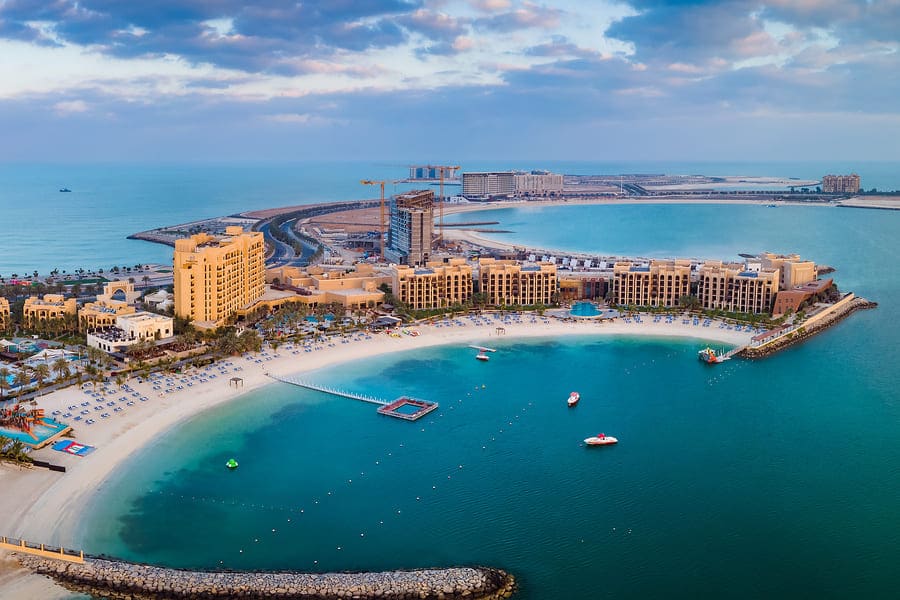
The new casino in Ras Al Khaimah is expected to attract additional tourists and boost rental income for property owners in the surrounding areas

How to get citizenship by real estate investment in the Caribbean

Obtaining Caribbean citizenship usually takes 6—8 months, based on Immigrant Invest experience. 

The process is entirely remote in all countries except St Kitts and Nevis. Applicants for a St Kitts passport must visit the country or an approved embassy or consulate to collect their Certificate of Registration.

P8M
1 day
Preliminary Due Diligence

Immigrant Invest conducts a preliminary check of the investor before signing a service agreement. This check helps to identify any risks of refusal early and address them promptly.

2+ weeks
Document preparation

The investor collects the required documents for the chosen program. Immigrant Invest experts translate and notarise documents when necessary.

3+ months
Due Diligence and application processing

The country’s authorities conduct Due Diligence on the investor and their family against international databases.

At this stage, applicants undergo an online interview. A translator is provided when required.

2+ weeks
Choosing and buying real estate

Immigrant Invest offers real estate options that meet the Citizenship by Investment program’s requirements. Once the citizenship application is approved, the investor proceeds with the purchase of the chosen property.

2+ weeks
Getting citizenship documents

After the investment is made, the authorities issue naturalisation certificates and passports.

Risks to consider before investing abroad

Legal and ownership restrictions. Some countries limit foreign property ownership or allow only leasehold rights. Regulations often vary by region or property type. For example, in Indonesia, foreigners can only acquire property through leasehold arrangements unless they use a local nominee or invest via a company.

Currency volatility. Fluctuations in exchange rates can affect both the initial purchase price and future returns. This is especially true if rental income is received in local currency while expenses are paid in hard currency.

Consider investing in countries with currencies pegged to the US dollar, such as the Eastern Caribbean states, or in markets known for low currency volatility.

Bureaucracy and lack of transparency. Complex paperwork, unclear registration procedures, or inconsistent enforcement can delay transactions and result in unexpected costs. 

In some Balkan and Middle Eastern countries, delays in title registration or zoning approvals are common.

Political or economic instability. Real estate is a long-term investment, and local conditions can change rapidly. Political shifts, tax reforms, or regulatory changes may affect your investment strategy. 

Terms for residence or citizenship by investment can also be amended or suspended, as seen recently in Portugal and Ireland.

Low liquidity. Property is not a liquid asset, and resale can take months, especially in emerging markets or remote resort areas. For instance, a holiday villa in a quiet location may generate rental income but attract few buyers when it’s time to sell.

Overdependence on tourism. Markets heavily reliant on seasonal tourism can be unpredictable. Changes in travel trends, local infrastructure, or regional security may significantly impact demand. Short-term rental income in coastal island nations often fluctuates with flight availability or global health concerns.

Management complexity. Owning property abroad typically requires local support, particularly for rental management, maintenance, and tax compliance.

It’s advisable to consult with experienced legal advisors before purchasing a property abroad. Immigrant Invest experts will help you choose a profitable option and explain all the risks to protect your investment.

Final thoughts about the best real estate investment countries

  1. Investing in overseas real estate offers both financial returns and migration benefits like rental income, capital growth, and access to residence or citizenship.
  2. Top real estate destinations in 2025 include Antigua and Barbuda, Cyprus, Dominica, Greece, Grenada, Malta, St Kitts and Nevis, St Lucia, Türkiye, and the UAE.
  3. Low-entry Caribbean programs appeal to families seeking second citizenship remotely. For example, Dominica grants it within 6 months for a $200,000 resort property investment.
  4. Türkiye offers the highest rental yields at up to 10%. The lowest rental yields of 3—5% are in the Caribbean countries.
  5. Obtaining citizenship or residency takes 3—8 months. The procedure usually includes preliminary Due Diligence, collection of documents, main Due Diligence, and purchase of a suitable property.
  6. Smaller markets may have lower liquidity, and changes to visa or citizenship rules can affect eligibility and timelines.

Frequently asked questions 

Which country is best for real estate investment?

The best country for real estate investment depends on your goals, whether you are seeking capital growth, rental income, residency rights, or lifestyle benefits. 

For stable returns and global mobility, Greece, Portugal, and the United Arab Emirates stand out. 

If low entry cost combined with citizenship options is your priority, Antigua and Barbuda, Dominica, and St Lucia offer compelling value.

Countries like Türkiye and Georgia attract investors with relatively low property prices and rapid urban development.

What country has the highest ROI on property?

Portugal, Bulgaria, and Croatia are among the top performers in terms of capital appreciation. The annual price growth there exceeds 13—16% according to Eurostat. 

For rental yield, Antigua and Barbuda and Grenada offer returns up to 8% annually on resort-based investments. 

Dubai in the UAE and Tbilisi in Georgia rank high for ROI due to tourism growth and relatively low maintenance costs.

Which countries offer the best rental yields for property investors in 2025?

Countries with the best rental yields are Georgia, Türkiye, and the United Arab Emirates. 

In Tbilisi, Georgia, short-term rentals can generate up to 7% annually due to strong demand from tourists and remote workers. 

In Türkiye, seafront apartments in Antalya and Istanbul typically deliver yields of around 6%, supported by growing domestic and foreign interest.

In Dubai, the UAE, modern flats in districts like Business Bay and Jumeirah Village Circle average between 5 and 7% rental returns, with high occupancy and strong long-term rental demand.

What is the best European country for real estate investment in 2025?

Greece stands out as the best EU country for real estate investment in 2025. It offers moderate entry prices, a recovering tourism sector, and a path to residency by investment with flexible family inclusion.

Investors can buy property in central Athens, Thessaloniki, or popular islands such as Crete.

Portugal and Bulgaria also remain strong contenders, especially for capital appreciation and retirement-oriented purchases.

Is now a good time to buy a house in Greece?

Yes, now is a favourable time to invest in Greek real estate. Although prices have risen steadily over the past three years, they remain below the EU average.

The Greek residency by investment program continues to attract international buyers. Urban areas like Thessaloniki and Athens offer strong rental demand, while coastal regions remain popular for lifestyle and holiday use.

Furthermore, Greece’s economy and tourism sector are both on stable growth trajectories, supporting long-term value.

Can investors sell Caribbean real estate after obtaining citizenship?

Yes. Investors can usually sell the property after the mandatory holding period, which depends on the country and is commonly 3 to 7 years. Selling the property after this period does not affect citizenship.

Immigrant Invest is a licensed agent for government programs in the European Union and the Caribbean.

30 best countries for property investment: updated list in 2026
Share:
Home Caribbean citizenship by investment: how to choose a program
30 best countries for property investment: updated list in 2026
Scroll to Top