The Vanuatu islands are a secluded corner of exotic nature. On the islands, you can climb active volcanoes, see the rare Kauri tree, which is older than the dinosaurs, and swim among the coral reefs.

The country is developing due to tourism and foreign investment, and cosmopolitans get Vanuatu citizenship to travel visa-free to the UK and Singapore.
Geography and nature of Vanuatu
Vanuatu is a small archipelago in the Coral Sea, consisting of 83 islands. Eighteen islands of the archipelago are uninhabited. Some of them are privately owned or put up for sale. The length of the islands from south to north is about 1,176 km.
Until 1980, the country was called the New Hebrides. And the new name says to the world, "this land is forever."
- Area ― 12,190 km²
- Capital ― Port Vila
- Average annual temperature ― +27°C
- Most comfortable months — July, August, and September
- Population — 319,000
- Official languages — English, French and Bislama
The topography of the Vanuatu Islands is mountainous. The peak of the highest mountain, Tabvemasana, reaches 1,879 m. The mountain is located on the country’s largest island, Espiritu Santo. You can climb the mountain in 5—6 hours with a guide or a guided tour.
There are several active volcanoes in the country. Scientists believe that one-fifth of the archipelago's land mass has appeared in the last 200 years. In addition to Espiritu Santo, the main islands of Vanuatu include Efate, Tanna and Malekula.
The capital of Vanuatu, Port Villa, is located on Efate island. It is 23.6 km² in size and is home to 52,000 people, which is ⅔ of the country’s population. Port Vila is also the centre of Vanuatu’s economy and transportation. The country’s Bauerfield International Airport is located here, and large cruise ships typically dock in the city’s port.
There are no large mammals, venomous snakes or spiders in Vanuatu. But the islands are home to many birds, reptiles, and insects, many of which are endemic. For example, out of 57 bird species, seven are unique inhabitants of the New Hybrids.


The climate in Vanuatu is tropical and generally humid. June, July, and August are the winter months. From May to October, south-easterly sea breezes arrive, keeping days warm and nights cool.
Temperatures in Vanuatu are stable. The rainy season falls in the summer and lasts from December to March. At the same time, cyclones pass through the islands, which are formed mainly over the Coral Sea.

Political and economic structure of Vanuatu
Vanuatu is a democratic parliamentary republic. The Head of State is the President, elected by the population for a four-year term. The official currency is the Vatu, with 1 vatu = ¢9.
Vanuatu is a member of the UN, the Commonwealth of Nations, La Francophonie, the South Pacific Commission and the Pacific Islands Forum. Therefore, the Vanuatu passport allows you to travel to the UK freely.
98.5% of Vanuatu's population is Melanesian, and 1.5% is European, Asian and Pacific Islander. Most Vanuatans live in tribal villages. In total, there are more than 30 tribes in the country that speak more than 115 local dialects. Vanuatans enjoy rugby and cricket.
The main religion on the islands is Christianity, which is practised by about 83% of Vanuatans. Of these, 28% are Presbyterian, 15% are Anglican, and 12% are Catholic. There are also Buddhists, Judaists, Muslims and representatives of other religions living in Vanuatu. And about 1.5% of Vanuatans consider themselves atheists.
Vanuatu has congregations of the Apostolic Australian Church, the Free Church, the French Protestant Church, and small communities of Jehovah's Witnesses and Mormons.


Vanuatu's economy is being developed through tourism, agriculture, animal husbandry, and investment from the citizenship program. GDP per capita is about $3,000.
In recent years, more and more people have been travelling to Vanuatu, and tourism contributes 20% of the country’s GDP. The beauty of nature and good ecology factors attracts visitors.
Vanuatu has almost no industrial enterprises, and the islands have preserved their unique nature and clean beaches. Australia, New Zealand, New Caledonia, England, and France provide a steady stream of tourists.
Vanuatu has one large Bowerfield International Airport and more than a hundred small local airports. Passenger turnover on domestic and international flights is approximately 350,000 people per year.
The three major ports of Vanuatu are Port Vila, Luganville, and Forari. The country's merchant marine fleet consists of approximately 160 vessels.
The total length of Vanuatu highways is just over 1,000 km, most unpaved.

Human rights in Vanuatu
The Constitution of Vanuatu is aimed at respecting and honouring human rights. The Government releases annual reports on human rights in the country.
The key takeaways from the 2021 report are the following:
- impunity for human rights abuse is not a significant problem;
- there are no government restrictions on academic freedom or cultural events, peaceful assembly, internal movement, foreign travel, emigration, and repatriation;
- while the law sees men and women as equals, patriarchal traditions in society still pose a threat to this equality;
- there was impunity for corruption.
Vanuatu is constantly working on improving human rights in the country. The following treaties have been approved so far:
- the Convention Against Torture;
- the Convention on the Rights of Persons with Disabilities;
- the International Convention on Civil and Political Rights;
- the Convention on the Elimination of All Forms of Discrimination Against Women;
- and several International Labor Organisation conventions.
The country also participates in UN Peace Keeping missions.
Taxation in Vanuatu
Taxes for individuals. The country has the same tax conditions for residents and non-residents. There are no taxes on personal income, wealth, inheritance, capital gains and export.
Taxes for legal entities. The Vanuatu Government uses low taxes to attract offshore companies. Thus, an International Business Company (IBC) registered in Vanuatu does not pay taxes for the first 20 years. However, businesses pay a fixed annual fee of $300. As a result of this policy, 15% of the country's GDP comes from IBCs.
VAT is 12.5% in Vanuatu.
The state’s banking system guarantees confidentiality. At the same time, Vanuatu complies with FAFT, an international organisation combating money laundering. As a result, Vanuatu does not experience the pressure that applies to offshore companies.
Taxes for real estate deals. Property ownership in Vanuatu is not taxed, but the deals are. The following rates apply:
- stamp duty — 5%;
- registration fee — 2%;
- VAT on the purchase of commercial real estate — 12.5%;
- tax on rental income — 12.5%.
Living in Vanuatu
Accommodations. Tourists stay in hotels, apartments or villas. The average rental price for a one-bedroom apartment starts at $1,200 ― the closer to the centre, the more expensive. Your own 50 m² apartment will cost about $41,000.
Prices. Vanuatu’s grocery prices are considered to be high, especially for imported goods:
- loaf of white bread ― $3.31;
- eggs, twelve in a package ― $5.60;
- local cheese, 1 kg ― $22.52;
- apples, 1 kg ― $4.43;
- oranges, 1 kg ― $3.40;
- tomatoes, 1 kg― $4.47;
- potatoes, 1 kg ― $5;
- chicken filet, 1 kg ― $18.78;
- bottle of a mid-range wine ― $12.71.
When planning to shop in Vanuatu, remember the opening hours. Local stores open from 07:30 to 16:30 on weekdays and from 07:30 to 12:00 on weekends and holidays.
There are many holidays in the country, so it’s best to shop in the morning. All stores are closed during the day's hottest hours, from 11:30 to 13:30.
Transport. A 30-day public transport pass costs about $57. The average price of a taxi ride is $1.14 per hour. Gasoline is around $1.43 per litre.
A ferry network connects the inhabited islands. Uninhabited islands can be reached by finding a boat with a captain and paying $20—50 per trip.
Attractions. The main attractions of Vanuatu are volcanoes, caves, waterfalls and endemics. Each island has its own unique flora and fauna, and some parts of Vanuatu are uninhabited and have not changed for hundreds of years. In the jungle, tourists visit underground caves and swim in the clear waterfalls.
The most popular beach in Vanuatu is the snow-white Champaign Beach on Espiritu Santo Island. Cruise liners and yachts dock on this island.
Tourists who want to see the eruption up close usually choose tours to the active Yasur volcano. Its height is only 361 m, and the crater’s diameter is 400 m. Jackie Chan’s flick Armor of God 3: The Zodiac Mission was filmed here.
The National Museum of Vanuatu is located in the capital city of Port Vila. It features 3,500 monuments of culture and art of the tribes of Vanuatu.
Big Bay National Park is the first park in Vanuatu, located on the island of Espiritu Santo. It has relict trees, in the shade of which more than 170 species of birds live, and 160 species of orchids hide.


Education and healthcare in Vanuatu
Education. Vanuatu has 101 elementary schools, an agricultural school, an institute of technology, a South Pacific University campus, and a teacher training college.
Most educational institutions are located in the capital. Citizens of the country who want a higher education often enrol in Australian and New Zealand universities.
Healthcare. Vanuatu has five public hospitals; the major ones are in Port Vila and Luganville. The other four are in different regions.
There are also 27 health centres and more than two hundred aid posts dispersed around the country. Vanuatu Private Hospital in Port Vila is the only commercial acute care facility in the country.
The local healthcare system is often criticised for its limitations, but the situation has been improving. The right to health in Vanuatu is 99.1% for children and 98.4% for adults, which is fairly high.
In 2021, the Government launched the Health Sector Strategy to establish full inclusivity for the disabled, single-parent families, people affected by the climate, the elderly, and other social groups. This will be done by ensuring universal health coverage, building more medical facilities, and developing preventive healthcare.
Currently, Vanuatu has public healthcare but has pitfalls, such as a need for more medical staff. Additionally, many healthcare workers will expect cash payments for their services.
It is advised to have private health insurance if you reside in Vanuatu. Choose a plan that will cover the treatment of injuries, viruses, chronic diseases, routine checks, hospitalisation, surgeries, laboratory work, and medical evacuation. You can also visit Australia or New Zealand for advanced treatment.
5 interesting facts about Vanuatu
#1. The history of Vanuatu started back in 1,300 BC. It is believed that the first settlers belonged to the Lapita culture, and archaeologists have discovered pieces of Austronesian pottery in the local soil.
# 2. Ni-Vanuatu or Ni-Van are the indigenous peoples of Vanuatu. They live mostly in rural villages and are the keepers of a rich and colourful culture.
#3. The peace between the tribes and villages of Vanuatu is celebrated by the Toka Festival, held every 3 years. During the festival, residents wear ceremonial outfits, perform ritual dances and drink kava, the local slightly hallucinogenic beverage.
#4. As the recent Happy Planet Index determines, Vanuatu is the second happiest place on the planet. The index is focused on well-being and environmental factors. Since 2006, Vanuatu consistently lands in the top 5. It was named the happiest country in the world in 2008 and the happiest one in the Asia Pacific in 2016.
#5. Bungee jumping mostly likely originates from Vanuatu, modelled after a Pentecost Island ritual. Called Naghol land diving, the ritual involved young men jumping from a 30-meter bamboo tower towards the ground, their feet tied to the tower using vines. It is a true leap of faith that proves these youngsters' vital energy and bravery.

Benefits of the Vanuatu passport
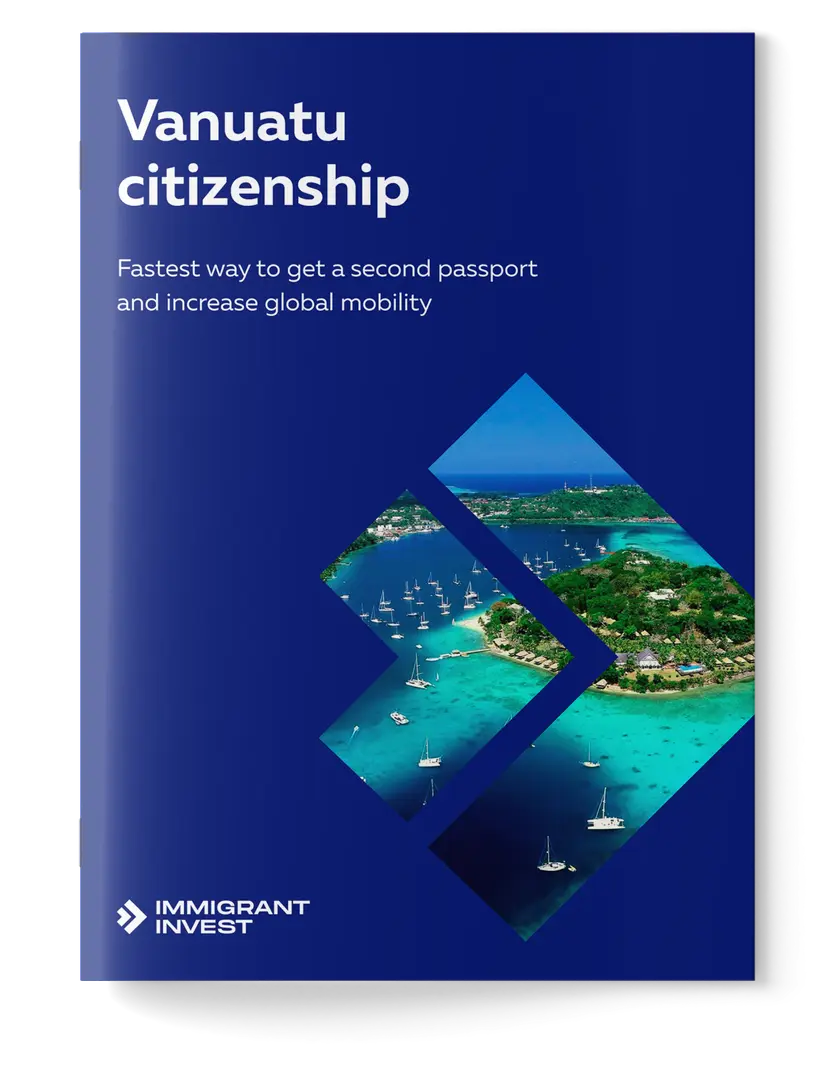
To increase Vanuatu’s GDP, the Government launched a citizenship by investment program in 2018. Today it is the fastest investment program in the world.

Investors contribute to the National Development Fund and get a passport in 1—2 months. For comparison, Caribbean countries grant a passport in 2—6 months. An investor needs at least 14 months and about a million euros to obtain EU citizenship.
The minimum contribution to Vanuatu’s NDF is $130,000.
Vanuatu is the only country in Oceania that grants citizenship in exchange for investment. The income from the CBI program helps the country’s economic development: the government puts the money into healthcare, education and agriculture.
The Vanuatu passport allows investors to travel visa-free to 108 countries, including Singapore and Hong Kong. Citizens can stay 180 consecutive days in the UK, 90 days in Hong Kong, and 30 days in Singapore.
The investor with a Vanuatu passport can:
- Apply for a B-1/B-2 tourist visa to the US, which will be valid for 5 years.
- Use the services of European banks, open accounts, conduct transactions, make deposits, and take out loans.
- Become tax residents of Vanuatu and optimise their taxes.
Frequently Asked Questions
Where is Vanuatu located?
The islands of Vanuatu are located in the waters of the Pacific Ocean. Vanuatu is bordered to the west by Australia, to the north by the Solomon Islands, and to the east by Fiji.
Do I need a visa to visit Vanuatu?
Not if you are a citizen of one of the 95 territories that signed visa waiver agreements with Vanuatu.
What documents do you need to enter Vanuatu?
To enter the country, you must have the following:
- Passport or ID that will remain valid 6 months after the planned trip
- Return tickets.
- Confirmed accommodation booked at an accredited tourist venue, such as a hotel, resort, villa, etc.
- Visa, for citizens of non-exempt countries.
If you arrive in Vanuatu with children, bring their birth certificates and, if applicable, a notarized child travel consent document from their parents or legal guardians.
If you and your family members obtain Vanuatu citizenship, you will be able do enter and exit the country with no restrictions.
How do I get Vanuatu citizenship?
An investment program is a fastest and easiest way to obtain Vanuatu citizenship. The investor contributes to the National Development Fund and receives a passport in four weeks. The contribution amount is $130,000 or more.
What does an investor with a Vanuatu passport get?
The second passport of Vanuatu gives investors freedom of movement around the world. Citizens of Vanuatu travel without a visa to 108 countries, including the UK, Singapore and Hong Kong.
An investor can also apply for a B-1/B-2 tourist visa to the US, use the services of European banks, and optimise taxation.
What attractions can you see in Vanuatu?
The main attractions of Vanuatu are the islands of Vanua Lava, Malakula, Mota Lava, Espiritu Santo, Efate and the coral Island of Ra. Each island has preserved its unique nature and is home to endemics. Hidden in the jungle are underground caves and pristine waterfalls.
White Champaign Beach is the most popular beach in Vanuatu. It is located on the island of Espiritu Santo. Cruise ships and yachts from all over the world stop nearby.
Tabvemasana is the highest mountain in the islands, with a peak of 1,879 m. But tourists often choose excursions to the active Yasur volcano; its height is only 361 m, and the crater diameter is 400 m. Vulcan hosted the filming of the popular movie Armor of God 3: The Zodiac Mission with Jackie Chan.
The National Museum of Vanuatu is located in the capital, Port Vila. It has the largest collection of 3,500 monuments of national culture and art from all over the country.
Big Bay National Park, the first park in Vanuatu, is located on Espiritu Santo’s island. In the park, there are relict trees, in the shade of which more than 170 species of birds live, and 160 species of orchids hide.
What is interesting about Vanuatu?
Vanuatu has a comfortable tropical climate, rich culture, and great ecology due to the absence of industrial plants. The archipelago is made of 83 islands with unique flora and fauna. Vanuatu has been in the top 5 happiest places in the world since 2006.
The country also has one of the fastest paths for obtaining citizenship by investment. Investors can get a Vanuatu passport in just one month in exchange for a $130,000+ National Development Fund donation.
Vanuatu citizenship allows them to travel to 108 countries, including the UK, Hong Kong, and Singapore, open accounts in European banks, and optimise taxes.
Is Vanuatu a good place to live?
Vanuatu is constantly placed in the Top 5 happiest places on the planet in the Happy Planet Index. It has a comfortable tropical climate, pristine beaches, gorgeous nature and rich culture. People here are warm and friendly.
The downsides of permanent living in Vanuatu include problems with advanced healthcare and risks of natural disasters.
But investors and expats that obtain Vanuatu citizenship are not required to stay in the country; they can only visit it periodically for vacation or business trips. They will keep the benefits of Vanuatu citizenship, such as visa-free access to 108 countries and a tax haven.
What language do Vanuatu nationals speak?
The free official languages of Vanuatu are English, French, and Bislama. The absolute majority of the population speaks English. Education in Vanuatu is conducted in English and French.
 Zlata Erlach